




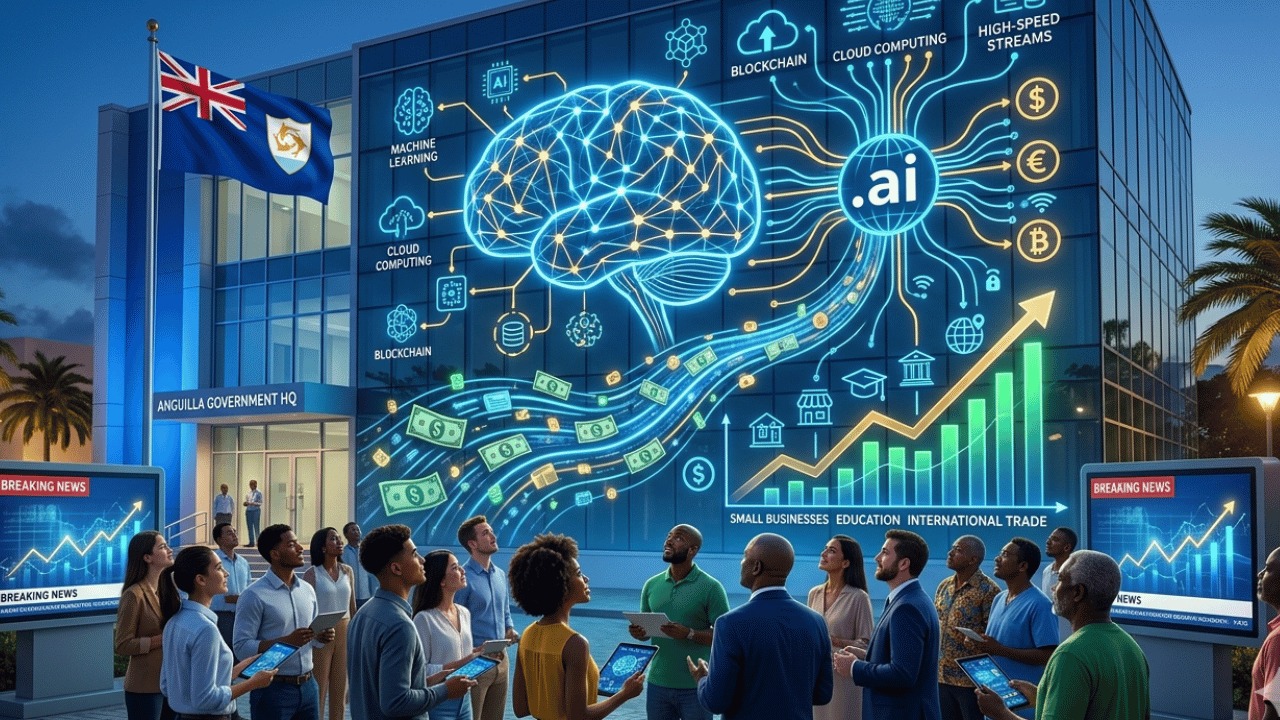

Kathmandu. A strange and fascinating scene has emerged in the international technology market. Anguilla, a small island country in the Caribbean Sea with a population of just about 16,000, is now making billions of dollars a year selling “invisible” things.
The island was once known only for its clean beaches and lobster. However, now its main ‘export’ is its Internet Country Code domain ‘AI’. Silicon Valley’s big tech companies and AI startups are scrambling to hang ‘AI’ on their website addresses, so the coffers of this small country have started filling up overnight.



In fact, Anguilla’s success was not the result of some grand plan. In the early 1990s, when a two-letter domain code was distributed to every country and territory, Anguilla was accidentally hit by “bash”. For many decades, there was not much income from it. But at the end of 2022, when AI technology like ‘ChatGPT’ surprised the world, the demand for the ‘AI’ domain skyrocketed.
In 2023 alone, the island generated about $32 million (about Rs 4.25 billion) from domain sales. That’s more than 20 percent of its total government revenue. By 2024 and 2025, this income is expected to rise even further to account for nearly a quarter of the government coffers.
This source of digital income in Anguilla is also very expensive. Registering an ‘ai’ domain has to pay a much higher fee than the usual ‘.com’ domain. Most companies will have to pay at least $160 to $180 for 2 years, and this fee can go upwards of $200 upon renewal.
For tech companies, this fee is linked to the “legitimacy” and identity of their brands. But, for Anguilla, it’s a pure ‘digital export’ with no environmental impact. The money is now being used to invest heavily in public services such as schools, roads and hospitals. This has given the government some relief from the compulsion to rely only on tourism.
For countries like Nepal with limited resources and small resources, Anguilla’s story could be an important lesson. It’s time to think about how our own country code ‘.np’ can be linked to specific digital branding or services.
However, there are its own risks to relying too much on a single sector. If AI technology loses its appeal tomorrow or the rules of the internet change, Anguilla’s economy could be hit again. So while these digital lotteries may change the face of the country, it is equally important to diversify the sources of income for the sustainable future.
In this way, a two-letter code changed the future of an entire nation, proving how powerful ‘digital assets’ are more than geography in the age of technology.