



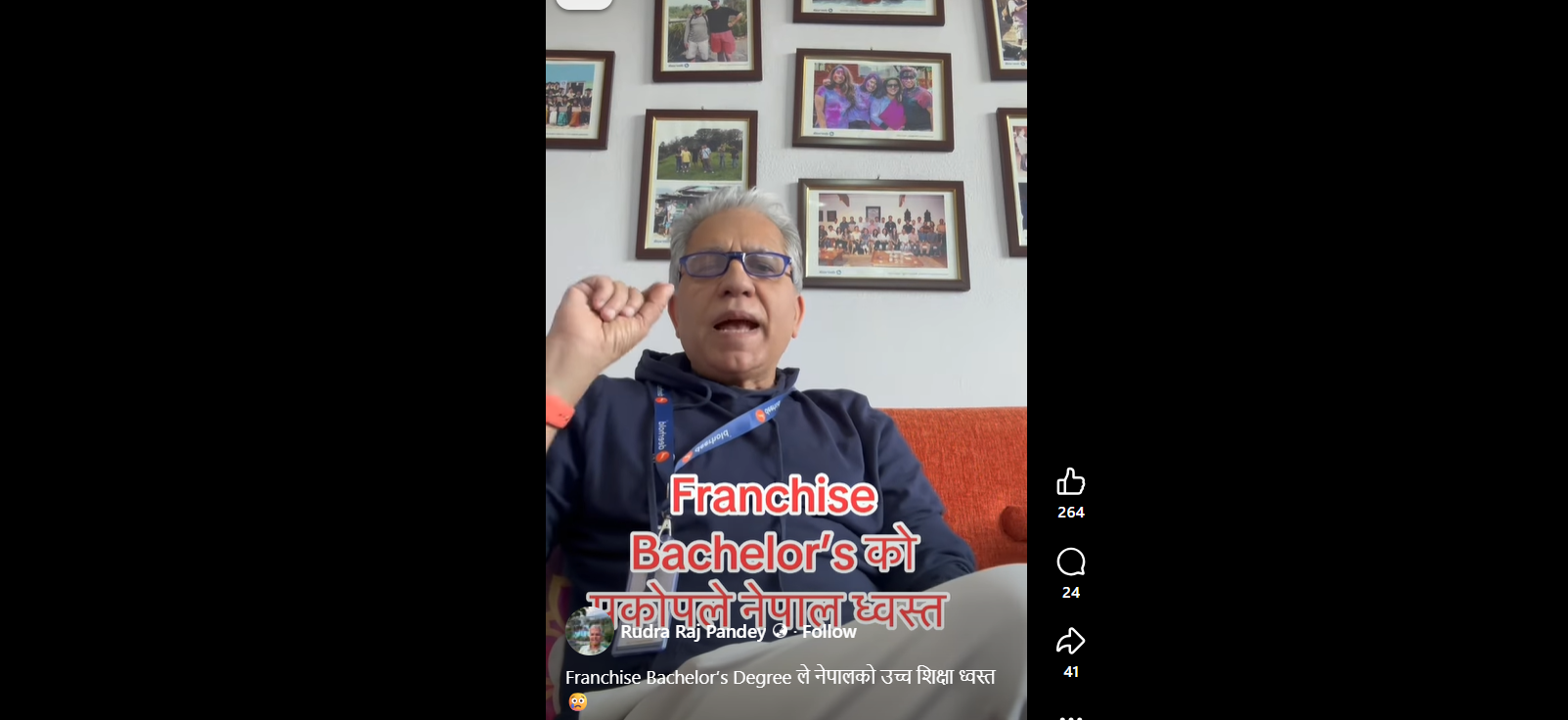

Kathmandu. In the last two decades, the number of foreign private colleges in Nepal has once again come to the center of controversy. The education sector has come under fire after Rudra Raj Pandey, the promoter of Deerwalk Group and a well-known entrepreneur in the field of information technology, has publicly levelled serious allegations against these colleges.
In a statement made public through a video post through his Facebook page, Pandey said, “Colleges opened with names like British, Boston, Texas, Prince are not education, they are franchise business. ”



His speech was not only emotional, it also raised serious questions related to academic acceptance, international acceptance of degrees, and the future of the student.
What is a franchise degree?
A franchise degree means that a university abroad allows its courses and degrees to be taught by a local private college, but the college and university model are geographically, administratively and educationally separated.
Pandey gives an example of this, “It’s like taking money from Himalayan Java Café and letting others use its brand. College here, university there. This is where the problem starts.
Serious allegations:
According to him, a bachelor’s degree from such a franchise college is not accepted by many reputed foreign universities for masters or Ph.D. degrees. Students are attracted to the idea that “it is easy to go to the UK and Australia”, but are later told in a rejection letter that ‘your Bachelor is not a Bachelor’.
In Nepal, these degrees are not fully accredited by Tribhuvan University or other public universities, but this is not explicitly stated when admitting.
The government, the Ministry of Education and the regulatory body have remained silent. Are these allegations just a personal grudge? This question is very important.
Rudra Raj Pandey himself runs a college affiliated to Tribhuvan University. So critics say, “Is he defaming foreign colleges to protect his own business?”
Government Warnings and Student Complaints:
In the last few years, the Ministry of Education has repeatedly issued public notices to take precautions before admission to colleges affiliated to foreign universities. Complaints have been filed against some colleges for conducting classes without permission, for fees not being transparent, and for giving false assurances.
Students have also protested at some of Kathmandu’s best-known foreign-affiliated colleges such as British College and Islington College, alleging that they have been duped by promising them “foreign study opportunities”.
Publicly available information and available facts show that Pandey’s statement cannot be completely dismissed.
Are all foreign-affiliated colleges bad?
Nope. It is also true that some colleges are actually conducting classes by having a formal agreement with a foreign university. Some students have been successful in working and studying abroad after studying in these colleges.
But the problem is the tendency to hide information, not explicitly state the extent of the degree, and sell the illusion of a ‘guarantee to go abroad’.
Strong message:
“If your goal is to get out of here and settle in the UK, it doesn’t matter what you read,” he said. But if your goal is to have a good academic career, research, PhD, and contribute something to the world, stay away from the franchise Bachelor. ”
Calling all foreign-affiliated colleges “scams” is an oversimplification. But the idea that all are safe, valid, and useful in the long term is also a dangerous fallacy.
Pandey’s criticism of being a businessman may have mixed with business interests, but many of his accusations are consistent with student experience, government warnings and policy shortcomings.
What will the government do to prevent students from being cheated?
The government should make a clear public list of which college’s degrees are valid and where. Colleges should clearly spell out the boundaries, risks and future of the degree when admitting. Parents and students should make decisions based on academic values and long-term goals rather than foreign names.