




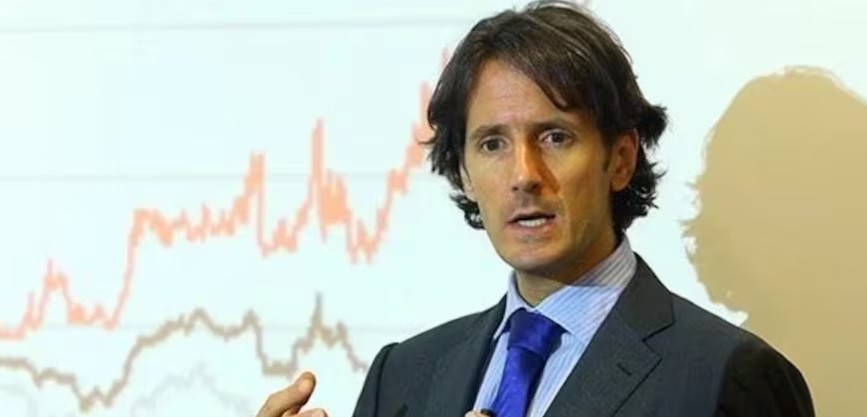

Kathmandu. Asian stock markets have been experiencing turmoil for some time and this may continue. Frederick Neumann, chief economist at HSBC, has warned of a major financial crisis similar to the one seen in Asia in 1997. He highlighted the parallels between the current economic situation and the situation that led to the regional economic collapse almost three decades ago.
In his note, the well-known economist, noting the sharp rise in US Treasury yields and the extremely weak position of the Japanese currency, the yen, said that the financial scenario that drives Asian markets today is similar to the devastating Asian financial crisis of 1997.



As global markets weigh the warning signs, Newman said, the ultimate threat to Asia has shifted from a weak banking system to a full reliance on U.S. pressure for artificial intelligence (AI).
Newman stresses that historical parallels are hard to ignore. Before the 1997 financial crisis, the U.S. 10-year Treasury bond yield rose from about 5% in October 1993 to about 8% in November 1994 and was about 7% by April 1997. To date, it has risen by about 80 basis points since February. It has reached about 4.79%. That is well above the historical low of 0.5% seen in August 2020.
According to those economists, the ongoing volatility in the currency market signals another warning. Between April 1995 and April 1997, the Japanese yen has depreciated by about 55% against the U.S. dollar. The Japanese yen has fallen from about 103 per dollar in January 2021 to a low of 163 in July. That’s a decline of 57%.
Frederick Neumann, citing these figures, argues that in both cases, the major causes of the crisis appear to be the same. In fact, despite the rise of the Internet in the mid-1990s, market momentum today seems to be driven by the growing influence of AI. Despite the differences between these two scenarios, Neumann stresses that the structural differences between 1997 and today far outweigh the similarities.
In the 1990s, Asian countries were capital importers and relied on foreign savings for domestic investment. This led to large current account deficits and weak banking systems. When borrowing costs rose sharply, foreign capital exited the country overnight. This led to widespread bank failures from Thailand to South Korea. Today, these economies are capital exporters. They hold large foreign exchange reserves. But Asia is facing new risks.
The growth in key regional production centers, including South Korea, Japan, Taiwan, and Singapore, is heavily dependent on electronics and semiconductor exports. In addition, U.S. tech giants are spending heavily on AI infrastructure.
Rather than financial insecurity as it did in the 1990s, Asia is now facing demand-related insecurity, Newman said.
According to the report, economists have said that if U.S. Treasury yields rise and rising borrowing costs force U.S. hyperscale companies to cut data center spending, or if the yen’s volatility destabilizes markets, Asian export hubs could have a direct and immediate impact. “This impact will not manifest itself as a panic on the trading floor of banks,” Newman said. “Instead, it will manifest itself as a quiet but rapid decline in the order books of top chipmakers.” — Agency