



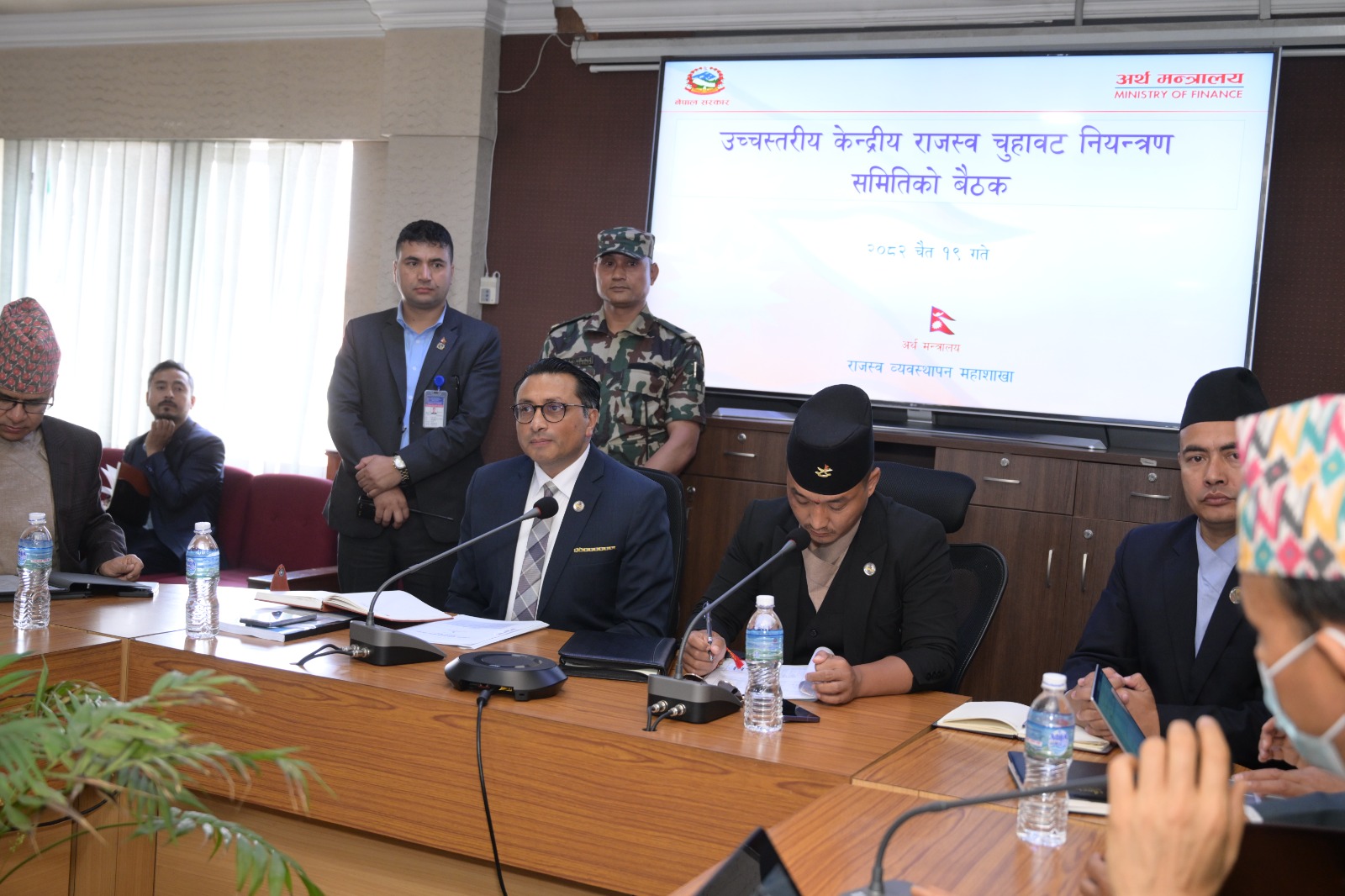

Kathmandu. A meeting of the Central Revenue Leakage Control Committee chaired by Finance Minister Dr Swarnim Wagle has been held at the Finance Ministry today.
Home Minister Sudhan Gurung, member of the House of Representatives Sushil Khadka, secretaries at the Office of the Prime Minister and Council of Ministers, Home Secretary, Finance Secretary, Revenue Secretary, Inspector General of Armed Police Force (APF), Chief Investigation Officer (National Investigation Department), Additional Inspector General of Police (Nepal Police), Director General of Customs, Director General (Inland Revenue Department), Director General (Department of Revenue Investigation), Director General (Department of Money Laundering Investigation) among others were present in the meeting. It was.



Chief of Revenue Management Division at the Ministry of Finance, Uttar Kumar Khatri, made a presentation on the current status of revenue, areas prone to risk of revenue leakage, role of bodies concerned to control revenue leakage, challenges in controlling revenue leakage and future course of action. During the discussion, the department chiefs apprised the ministers about the efforts and problems faced by their respective bodies to control revenue leakage.
In the meeting, Home Minister Gurung directed the authorities concerned to stop the tendency of one body sidelining and blaming another, to prepare a dedicated action plan with a deadline to control the problems of revenue leakage, to make all bodies resourceful and to make arrangements for additional infrastructures and equipment at the checkpoints.
Concluding the meeting, Finance Minister Wagle said that the tendency of not working in a mission model is the only reason why the administration which has proved to be capable of managing big tasks and incidents has not been successful in regular works. He presented a clear roadmap for the government to carry out works of regular nature in a task model, to adopt a policy of reducing the revenue rate and increasing the scope of revenue and to focus on systemic reforms. He pledged to create an environment conducive for tax compliance and bring the people, groups and classes involved in smuggling towards self-employment and entrepreneurship through the state’s policies.
The meeting concluded with a decision to reduce the number of non-filer taxpayers, to work in a way that shows results from today, to resolve the issues related to tax disputes at the earliest, to emphasize on capacity development of bodies and human resources involved in controlling revenue leakage and to continue the systemic reforms.