





- Chandranath Upreti
}
With the journey of economic and social development in Nepal, the nature of natural and human risks is also constantly changing. Along with the effects of earthquakes, floods, landslides, inundations, avalanches, glacial and glacial lake events, fires, lightning, and climate change, the damage caused by epidemics, road and industrial accidents, agitations, vandalism, arson and other human activities are also having a serious impact on individuals, families, businesses, infrastructure, and the overall national economy. Past experiences and recent developments clearly show that the risk of disaster in Nepal is not limited to just a single natural event, but is becoming multidimensional and gradually complex.



The devastating earthquake of 2072 was one of the biggest natural disasters that Nepal has ever experienced. It caused huge human loss and damaged millions of homes and buildings, schools, health institutions, roads, bridges, historical heritage, industries and commercial property. The state had to mobilize a large amount of financial resources for reconstruction and rehabilitation. The earthquake taught us an important lesson that we may not have control over when a disaster will come, but the economic damage from a disaster can be prepared before it strikes. For this, insurance is an important and indispensable financial tool.
After the earthquake of 2072, there has been some awareness about the importance of insurance, but a large part of our wealth is still not adequately insured. People may run a home, business or industry by investing the money they have saved throughout their lives, but they are hesitant to take the insurance needed to transfer the risk of that property, and some may not even know about insurance. There is still a tendency in Nepali society to feel the need for insurance only after a disaster strikes. In fact, insurance is not a matter to remember only after a disaster, but it is a financial preparation done before the disaster strikes.
Floods, landslides, and inundation incidents have been causing great damage in Nepal in the intervals of a few years. Floods and landslides in 2080 and 2081 BS and various natural phenomena that followed have had a big impact on roads, bridges, hydropower projects, agriculture, livestock, homes and businesses. With climate change, the melting of glaciers and the formation of hilly terrain are also making the risk more complicated in the future.
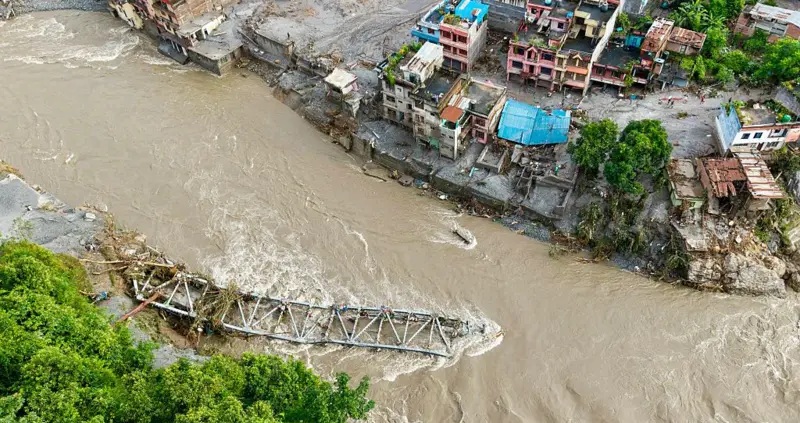
The most recent and serious example of this changing risk is the devastating incident that took place in Rasuwa and the Nepal-China border area on August 23 as a challenge before us. After the glacier and glacial rock collapse in the high mountainous region on August 23, the massive mudslide in the Bhotekoshi area of Rasuwa and flash floods caused widespread destruction in various areas of the Timure, Syaphrubesi, Betrawati and Trishuli corridors of Rasuwa, causing loss of thousands of lives and affecting roads, bridges, buildings and hydropower projects.
Thus, the occurrence of glacial lake bursts, floods, glacial and glacial bursts makes it very clear that the Himalayan risk is no longer limited to the possible outburst of glacial lakes already identified, but also to the possibility of sudden catastrophic floods from glaciers, rocks, formafrost, natural dams and instability in the Himalayan terrain.
The recent incident in Rasuwa has also forced a new way to think about the risks in Nepal’s hydropower sector. A large number of hydropower projects and projects under construction are located in rivers and mountain valleys. The recent disaster has caused major damage to various hydropower structures and has also significantly affected the national power generation capacity. This has made it seem that the traditional approach of insuring hydropower projects based on the risk of minor monsoon floods or traditional floods may no longer be sufficient.
It is not appropriate for us to make a risk assessment only on the basis of ‘such an incident has not happened in the past’ while constructing a project. Due to climate change and rapid changes in the mountainous terrain, the data of the past may not represent the entire risk of the future. Therefore, there is a need to link climate risk assessment, disaster modelling, geological assessment, early warning system÷disaster-resistant design with insurance in hydropower and other large infrastructures.
The Rasuwa incident has also raised another important question, if such a big disaster occurs at once, how much can our insurance sector bear the burden of claims? In the event of a major earthquake, devastating flood or mountain catastrophe, thousands of insured people can claim at the same time. In such a situation, it is difficult to bear the entire risk with the financial capacity of the insurance companies alone. Therefore, the role of disaster risk management, adequate reserve and capital adequacy, and especially reinsurance, becomes even more important.
There is a need to seriously study the feasibility of disaster insurance bridges or disaster risk bridges in Nepal. This will help and facilitate the allocation of the risk of major natural disasters to various insurance companies, reinsurance companies and international risk markets. The system of keeping the risk that the insurance company can afford and transferring the remaining risk through a proper reinsurance system should be made more scientific and risk-based.
Reinsurance is one of the backbone of Nepal’s insurance sector. Especially in a country like Nepal where the risk of earthquakes, floods, landslides and mountains is high, the ability to transfer the risk of disaster to the international reinsurance market is required. In the coming days, the feasibility of disaster modeling, parametric insurance, alternative risk transfer and other innovative risk financing mechanisms should be studied along with traditional reinsurance.
While discussing the economic impact of natural disasters, the corona epidemic cannot be forgotten. The corona epidemic has had a serious impact not only on the health sector but also on industry, trade, tourism, hotels, transportation, education and employment in Nepal. Many businesses were closed for a long time and the sources of income were affected. This made it clear that the risk is not only the loss of physical assets but also the loss of income due to not being able to operate the business is a big economic risk. There is also a need to think more about the appropriate insurance and financial structure for the financial arrangements related to business disruption and epidemic risk in the future and other emerging risks.
Similarly, there is a need to take seriously the risks posed by human activities due to arson, vandalism, damage to physical infrastructure and disruption of business activities in various places during the Jenji Movement in August 2082. Such incidents can cause direct damage to industrial factories, industries, shops, business offices, vehicles and other property, and may also cause indirect economic loss when the business is closed. This shows the need to provide clear information to the insured and businessmen about the management of risks such as riots, strikes, civil unrest, malicious damage and disruption of business.
One important thing to understand here is that not all damages are automatically compensated by insurance. The claim is evaluated on the basis of the risks, exceptions, terms and conditions of the policy, the amount deductible and the insured covered in the insurance agreement. Therefore, it is also an important responsibility of the insurance company and the intermediary to clearly explain the actual coverage and limitations to the insured while insuring. It is not only the insurance or not, but the amount of insurance is important for which risk.
In Nepal, the non-life insurance sector can make a big contribution to reducing the economic impact of natural and human disasters. Insurance for houses, buildings, industries, hotels, warehouses, and commercial property helps to manage financial losses due to earthquakes, fires, floods, landslides, etc. Motor insurance covers the damage to one’s own vehicle due to accidents and liability to third parties. Agriculture, livestock insurance can protect the investment and income of the farmers from natural hazards. Engineering insurance plays an important role in the risk management of roads, bridges, tunnels, hydropower, and other infrastructure sectors.
In the insurance system of the future, there is a need to emphasize on business interruption insurance along with property insurance. Apart from the human casualties, the incident has not only damaged roads, bridges and industries, but also affected the trade, transportation, tourism, supply and employment of the region. Therefore, it seems that the time has come to look at the direct property damage and indirect economic damage from the point of view of risk management.
The biggest test of insurance after a disaster is in claim payment. In times of crisis, the insured should not be kept in paperwork and long waits. The use of technology such as digital claim registration, mobile-based documentation, GPS, drone, satellite imagery, digital survey, and automated assessment should be increased. Implementing a fast-track claim settlement mechanism during a major disaster can help the insured get financial assistance faster and also help in increasing public trust in insurance.
In the future, the role of the insurance company should not be limited to issuing insurance and paying claims. The insurance company should become a risk management partner. In industry and business, insurance can be linked to services such as fire safety assessment, engineering inspection, disaster preparedness, business continuity planning and climate risk assessment. This reduces the risk of the insured and also reduces the risk of claims of the insurance company and increases the resilience of the overall economy.
Increasing disaster risk is not only a challenge for the insurance sector but also a huge business opportunity. New products such as climate risk insurance, parametric insurance, micro insurance, small and medium enterprises (SME) insurance, agricultural insurance, cyber insurance, business interruption insurance and infrastructure insurance can be developed. If simple, low-cost and need-based package insurance can be developed, especially for small and medium businesses, the access to insurance can be widened and accessible to the rural level.
However, the tendency to accept the business at a lower premium, to reduce the risk selection, to reduce the risk selection, or to not clarify the terminology mentioned in the insurance policy, without properly assessing the risk of insurance, can cause problems for both the company and the insured in the long run. The real success of the insurance business depends not only on the collection of the premium, but also on the ability of the company to fulfill its commitments in the event of a disaster. Therefore, prudent underwriting, appropriate pricing, proper monitoring of risk, internal control, fraud management and strong reinsurance arrangements should be preferred.
The tendency to consider insurance as an expense, lack of insurance literacy, lack of access to insurance services in rural areas, lack of suitable products for small businesses and misconceptions about claims have hampered the expansion of insurance. Therefore, it is necessary to launch a campaign to ‘pay insurance’ instead of ‘selling insurance’. It is necessary to create an environment where citizens can identify the risks to their property, business and income and get proper insurance.
For this, effective coordination between the government, local level, regulatory bodies, insurance companies and reinsurance companies is necessary. It is also necessary to develop policies to promote insurance in high-risk areas, to insure government property and infrastructure, to make agriculture and livestock insurance more effective, to involve the local level in risk assessment, and to provide appropriate incentives to the insured citizens and businesses. The regulatory body should also monitor risk-based supervision, capital adequacy, adequate reserves, reinsurance and claim payments on an effective and regular basis.
The recent disaster in Rasuwa has sent another important message that the risk of climate change is no longer just a matter of the future, but an economic reality of the present. Risks related to temperature rise, glacial changes, unstable rock formations and glacial lakes and natural dams in the Himalayan region can have long-term effects on Nepal’s settlements, roads, tourism, hydropower and commercial infrastructure. The recent disaster has called for a complex and series of risk assessments going beyond the traditional flood risk assessment.
Therefore, it is time to move beyond the idea of ‘relief in case of disaster’ and develop an integrated system of risk prevention, risk mitigation, risk transfer and rapid recovery. Insurance can be an important foundation of that system.
Whether the disaster is natural or human, its economic impact extends to individuals, families, businesses, banks and financial institutions, and ultimately to the economy of the nation. Therefore, risk management should be made an integral part of the development process. The earthquake of 2072, the floods and landslides of 2080 and 2081, the Corona pandemic, the Jenji movement of 2082 and the recent devastating flash floods in the Rasuwa-Bhotekoshi region have given us the same message that sustainable economic development is not possible by ignoring the risks. It may not always be possible to prevent disasters. But the impact of economic damage from disasters can be minimized. It is wiser to ensure economic security by assessing the risk before the disaster strikes rather than calculating the damage after the disaster strikes.
Therefore, the insurance sector in Nepal should not only provide insurance but also play the role of understanding the risk, reducing the risk, transferring the risk and helping in the economic recovery after the disaster. Nepal’s insurance sector can fulfill its real role only if the policy commitment of the government, effective supervision of the regulatory body, professionalism of the insurance company, capacity of the reinsurance market, activism of the local level and insurance awareness of the citizens can move forward together.
Therefore, in the coming days, the goal of Nepal’s insurance sector should not only be to increase the access to insurance but also to build the resilience of insurance. If insurance can be established not only as the financial security of individuals and businesses but also as an important part of national disaster risk management, then the economic damage caused by natural and human disasters can be managed to a great extent.
(The writer is former Assistant CEO of Nepal Insurance Company) )