




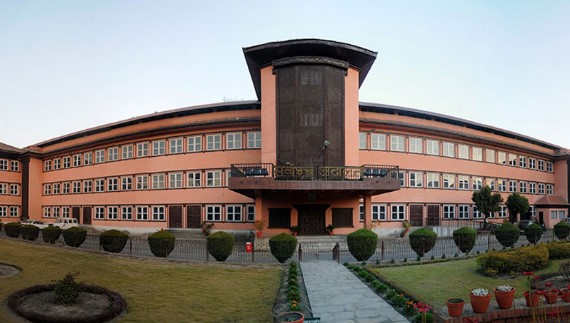

Kathmandu. The Supreme Court has held that any action taken by Nepal Rastra Bank against the directors and chief executive officers (CEOs) of banks and financial institutions will create legal disqualification }. The court has rejected the argument that the action taken by the Nepal Rastra Bank (NRB) to ‘warn’ or ‘admonish’ does not create disqualification TAG_OPEN_span_67TAG_CLOSE_span_68 as it is normal in nature.
Supreme Court Justices Dr. A division bench of Justices Nahakul Subedi and Nripa Dhwaj Niraula issued a directive order in the name of Nepal Rastra Bank (NRB) to maintain good governance in the banking sector TAG_OPEN_span_64TAG_CLOSE_span_65.



Key facts and background of the case
Advocate Madhu Kumar Chaulagain had filed a writ petition at the Supreme Court naming Nepal Rastra Bank (NRB) and the Board of Directors and CEO of nine commercial banksas defendants.TAG_CLOSE_span_63 The w TAG_OPEN_span_62rit petition was filed against Prabhu Bank, Global IME Bank, Himalayan Bank, Nabil Bank, NIC Asia Bank, Kumari Bank, Prime Commercial Bank, Garima Bikas Bank, Reliance Finance, among other banks.
Advocate } Legal provision that a person who has been taken action by the regulatory body under clause (d) of Section 18(1) of the Bank and Financial Institutions Act (BAFIA), 2073 is disqualified from being a directorTAG_OPEN_span_59TAG_CLOSE_span_60. They have demanded that the directors and chief executives who have been taken action against them should be relieved from their posts as it would be illegal for the people who have already taken action by the Rastra Bank to remain in the post.TAG_OPEN_span_58TAG_CLOSE_span_59
The Nepal Rastra Bank (NRB) had taken action against the directors and executives of the defendant banks and financial institutions in the fiscal year 2080/081 for violating the regulation as per clause (a) of sub-section (2) of Section 100 of the Nepal Rastra Bank Act, 2058 }.
In the reply, the defendants argued that was a normal action to ‘warn’ or ‘warn’ due to an operational error in accordance with Section 100(2)(a) of the Rastra Bank Act and that {{TAG_OPEN_span_54}}{ is to be relieved only if ‘order to remove or retire from office’ under clause (e) of Section 100(2) of Section 100(2) of the Rastra Bank. They claimed } } {{}}{{}}{{}}}.
The Supreme Court has partially corrected the argument of the Rastra Bank and the banks, holding a far-reaching conclusion regarding legal incompetence. The following are the findings of the Supreme Court in }{TAG_CLOSE_span_50}}{
1. Action cannot be classified as ‘general’ or ‘special’
The Supreme Court has ruled that the action taken by the Rastra Bank under Section 100 (2) of the Nepal Rastra Bank Act, 2001 should be considered as a situation where the regulatory body has taken action for acting against the law TAG_OPEN_span_48TAG_CLOSE_span_49.TAG_CLOSE_span_48″When the law categorises all the punishments in the same category, the defendant Nepal Rastra Bank in its written reply categorizes the punishment as ‘general’ and ‘special’ in nature and cannot be said to create disqualification as per Section 18 (1) (e) of the Bank and Financial Institutions Act, 2073 BS,” the court said in its verdict. “
2. Interest rate fluctuations that create disqualification
TAG_OPEN_span_46TAG_CLOSE_span_47 The court has concluded that the Rastra Bank has punished the officials of the banks and financial institutions for indulging in the interest rate on deposits and loans and thereby acting against the interest of the general depositors.The Court has made it clear that such action or punishment would constitute a legal disqualification }. The court concludes that it is not reasonable to say that } will not create the disqualification prescribed by the law.
3. A person who has been prosecuted is ineligible for a new appointment
According to Section 18(1)(d) of the Bank and Financial Institutions Act, 2073, a person whose action has been taken by the regulatory body or a period of 5 years has not elapsed since such action is taken {{TAG_OPEN_span_40} {{}}}.This provision is equally applicable to the Chief Executive Officer pursuant to Section 29(5)(d) }. Therefore, persons who have been taken into action by the Rastra Bank are not legally eligible to be appointed to the post of new Director or CEO for 5 years }.
The court has issued the following order balancing the petitioner’s demand and the legal process:
}
Writ Petition Dismissed:
According to the supremacy of Section 109 of the Nepal Rastra Bank Act, 2058 and the legal process under Section 19 of the BAFIA, the Rastra Bank itself does not appear to be automatically relieved of the post until the Rastra Bank itself issues a specific order ‘to remove or retire from office’ pursuant to clause (e) of Section 100(2 TAG_OPEN_span_33TAG_CLOSE_span_34). Therefore, the order as claimed by the petitioner seeking to be dismissed directly could not be passed and the writ petition is liable to be dismissed .
Directive Order in the name of Rastra Bank:
}
Even if the writ petition is dismissed, it is the responsibility of the Rastra Bank to mandatorily comply with the legal provisions relating to the disqualification of the persons who have been taken action by the Rastra Bank }. In order to maintain good governance in the banking sector and increase the credibility of the general public towards the financial system, the court has issued a directive order in the name of Nepal Rastra Bank (TAG_CLOSE_span_28 NRB), “To write to the concerned banks and financial institutions to mandatorily comply with the legal provisions regarding the disqualification of directors and officials of banks and financial institutions and to monitor whether or not there is compliance Get it done. “
The court said that the brief verdict was prepared on the basis of the digital records of the case management system as the case files and notebooks were not found due to the incident of arson that took place at the Supreme Court on September 10, 2002.