




Kathmandu. In the last few years, Nepal’s information technology (IT) sector has been developing rapidly. With the advancement of technology, IT companies, start-ups and innovation centers are being established not only in the federal capital Kathmandu Valley but also in the provincial cities of Butwal, Dharan, Janakpur and remote rural areas.
It has become common for the young generation to seek jobs in the technology sector and investors from abroad are attracted to the Nepali IT industry. They have been proving themselves to be excellent in technology and have been recognizing and representing Nepali skills and art at the world level.



From software export to tourism promotion, Nepali youths are making technology tools to promote the unique identity of Nepalis every day. Not only this, Nepal is also moving towards becoming the hub of IT as a country with cheap, reliable and number one technology in the world. But amidst this euphoria, the real challenges in the region are still inevitable. Structural weaknesses, outdated legal frameworks, policy ambiguities, and lack of institutional coordination have prevented the full potential of the Nepali IT industry from being realized.
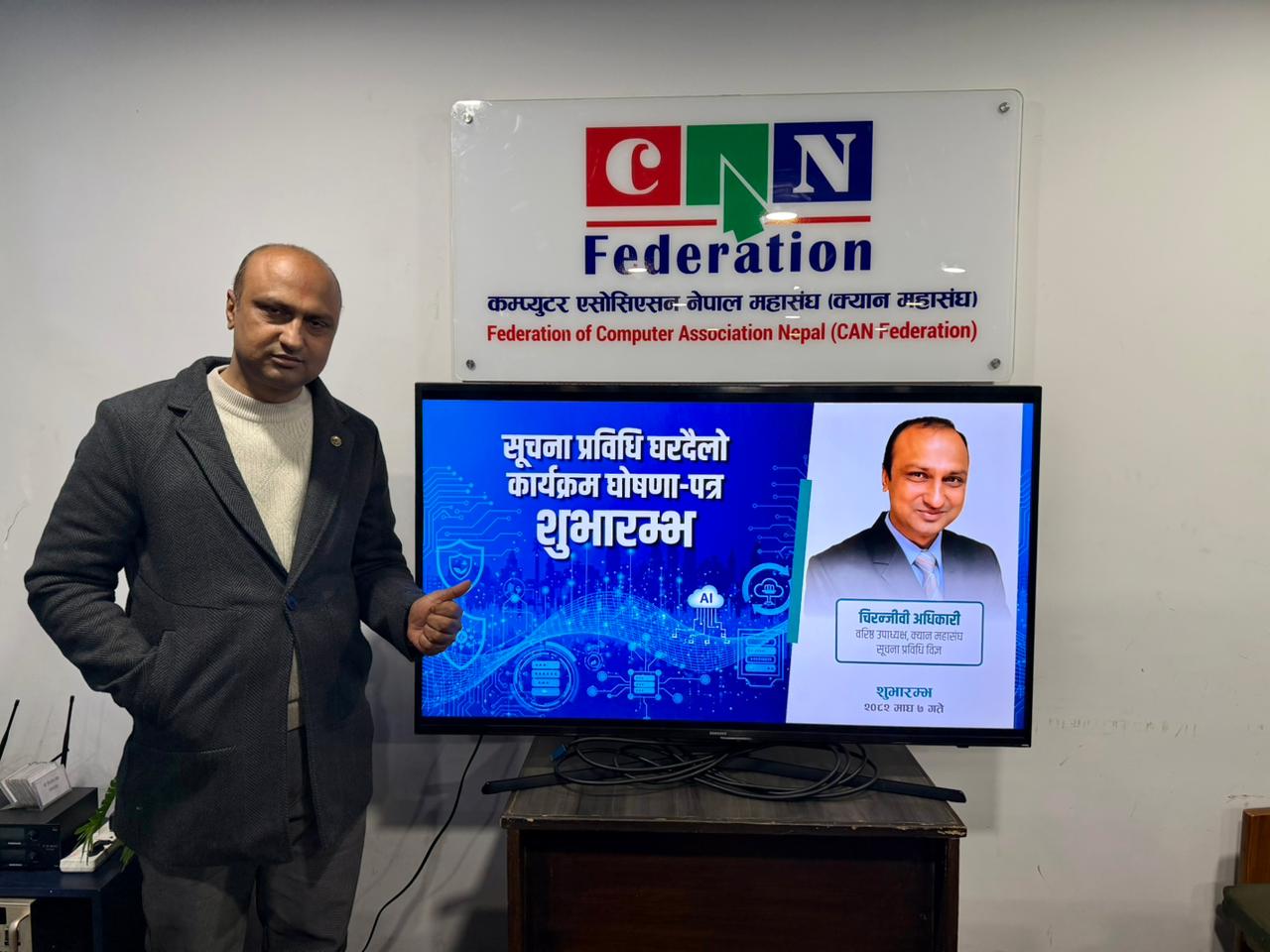
In view of this, Chiranjibi Adhikari, Senior Vice President of Federation of Computer Association Nepal (CAN Federation) and Cyber Security Expert, has formally launched a campaign called ‘Information Technology Door-to-door Yatra’. The campaign, which was launched on the occasion of his birthday, is not just a personal initiative but a policy movement related to the entire Nepali IT sector. Adhikari’s goal is to convey the real problems of the IT sector to the government, policymakers and political parties.
Background and Requirements of the Campaign
The government of Nepal had announced the ‘Digital Nepal Framework’ a few years ago. It promised to prioritize the development of digital infrastructure, digital literacy, e-governance, innovation and digital economy. However, various challenges in implementation are preventing the dream of Digital Nepal from being fully realized. Lack of coordination between ministries and government bodies, lack of clear policies and action plans, inability to deal with new challenges in outdated legal frameworks and technology have increased the risk of keeping the plan on paper.
According to Adhikari, Digital Nepal should not be limited only to plans and manifestos. Its actual implementation has to be linked to the real problems in the IT sector. We aim to make these voices heard directly and reach out to the policy makers through the ‘door-to-door’ campaign.
Old law and new challenges
The ‘Electronic Transaction Act, 2063’ is the main basis of the legal framework in the information technology sector in Nepal. But the Act is almost two decades old. At that time, technologies like artificial intelligence (AI), cloud computing, blockchain, big data, Internet of Things (IoT) were unimaginable.
In today’s digital age, data is considered as the new ‘oil’. However, Nepal’s legal framework has not been able to adequately address essential issues such as data protection, privacy, algorithmic accountability, and data ethical use. This has confused foreign investors and made it harder for local startups to compete in international markets.
“We have talented young talent, great start-up ideas, but outdated laws and policy ambiguities limit our capacity. If the dream of Digital Nepal remains only on paper, then the enthusiasm of the youth can be shattered. ’
The ‘door-to-door’ journey aims to identify these legal gaps and create a blueprint for new, modern and technology-friendly laws.
Lack of Data Exchange Platform
}
In Nepal, citizens are still compelled to submit the same details time and again even if they go for government services. Basic data such as citizenship, birth registration, educational certificates, tax returns cannot be automatically shared between different government agencies. The main reason for this is the lack of a secure and central data exchange platform.
Adhikari’s campaign says it will take this problem seriously. It is believed that the integrated data exchange system will speed up the delivery of government services, reduce corruption and save time and expense of the citizens.
Cybersecurity expert Dr. Rabin Shah says, “Since Nepal does not have a data exchange system, citizens have to submit the same details again and again. Only after this system is introduced, government services will become fast and transparent. ’
According to experts, through a secure data exchange system and modern e-governance, government services can not only increase efficiency but also transparency and accountability.
Data Center and Data Sovereignty Challenge
}
Lack of adequate and state-of-the-art data centers is another serious problem in Nepal. Most of the important data of government and private organizations is hosted on foreign servers. This poses a direct risk to ‘data sovereignty’.
Cybersecurity experts warn that storing sensitive citizen data abroad increases the potential for cyberattacks, data misuse and geopolitical risks. ’
Luca Jones, a US-based digital economy expert, says that unless Nepal builds its own data center, national security will remain a challenge. Keeping sensitive data on foreign servers means opening the country to any cyberattack or political pressure. ’
The door-to-door campaign has planned to conduct a national-level study on the need of secure data centers, feasibility models and how these can be developed through public-private partnerships (AAA).
Journey focused on startups and innovation
}
The campaign plans to visit the workplaces of at least 100 information technology companies and conduct a study. Startups, software development companies, cybersecurity firms, organizations focused on artificial intelligence and financial technology are prioritized.
The challenges faced by startups — lack of investment, tax structure, foreign payments, intellectual property rights, complexity of government processes — will be directly documented.
Startup entrepreneur Sumit Shrestha says, “We have great technology and capabilities but without government support, it will be difficult for us to compete in the international market. The door-to-door journey will convey the real problems we face to the policymakers. It’s a great opportunity for young people. ’
Cyber Security and National Security Dimensions
In the digital age, cybersecurity is not just a technical issue, but a subject directly related to national security. Cyberattacks on banking systems, energy grids, telecommunications, and government information systems can affect the stability of the country.
Since Adhikari himself is a cyber security expert, cyber security has been given special priority in the campaign. Concrete recommendations will be prepared on the National Cyber Security Policy, strengthening the Emergency Response Team (CERT) and human resource development.
Manju Shah, head of Nepal’s cybersecurity department, says, “We have a good policy but its implementation is challenging. The door-to-door campaign will combine policies, laws, and experience of startups to find practical solutions. ’
2026 Elections and Digital Commitment
In view of the 2026 elections, the campaign aims to put pressure on political parties to give priority to information technology in their election manifestos. In the past, there was a tendency to see the IT sector only as an ancillary subject. But now, digital economy, cybersecurity and technology-based jobs should be the mainstay of national development. Through this campaign, political parties will be asked to make clear ‘digital commitments’. It will be called upon to invest in digital infrastructure, startup-friendly policies, cybersecurity strategies and digital literacy programs to be included in the manifesto. At present, various political parties are using many platforms like Facebook, X, Tiktok, Instagram for their election campaigns. This digital platform seems to be taking over the economy as well as the flow of information. Regarding this, digital information information Ujjwal Acharya says, “Social media has now become the main medium of technology and information flow. No political party can exist without campaigning on it.
Most of them are young political leaders who have intensified their campaigning on social media. For example, Balen Shah, Ravi Lamichhane, Nepali Congress President Gagan Thapa, Pushpa Kamal Dahal, KP Sharma Oli and the new generation of celebrities and artists are using social media platforms as their uncles. He said that along with its use, the leaders and cadres of the political parties are also facing some challenges. According to him, due to the lack of proper use of social media, leaders and artists are becoming the target of trolls, going viral and eventually becoming victims of cybercrime or hackers. It explores cybersecurity challenges and long-term solutions.
National Information Technology Manifesto
}
A national information technology declaration will be prepared incorporating all the facts, suggestions and studies collected from the ‘door-to-door’ journey. It will be formally handed over to the government and top political leadership.
The Declaration is not just a document of recommendation, but a long-term digital roadmap. It clearly presents the policy, law, infrastructure and innovation needs and measures for Digital Nepal.
Conclusion: Milestone in the direction of Digital Nepal
}
Policy reforms, structural investment and political will are essential for the sustainable development of the information technology sector in Nepal. Chiranjibi Adhikari’s ‘Information Technology Door-to-door Yatra’ campaign has tried to bring all these aspects on a single platform.
This campaign is an important initiative not only to highlight the problems of IT companies and startups but also to influence the policy, law and political will towards realizing the dream of Digital Nepal.
The CAN Federation held a panel discussion with ICT policy makers, IT advisors, Asian Development Bank, World Bank, IT advisors to Prime Minister, data center researchers and stakeholders of Nepal Chamber of Commerce. They demanded that the private sector should implement the Digital Nepal Framework 2.0 in practice and not just a political issue.
Bigyan Shrestha, president of Nepal Chamber of Commerce’s Information Technology, shared his bitter experience that no one has been able to stop the youths from creating an environment in the technology sector. He says, “There is neither the basis nor the environment to do so in technology to find out why the youth are now leaving.” For example, when a young person opens an IT company, there is no concrete law about which government agency to register. Everyone is responsible. But we don’t know who actually has the power. As a result, young people are not allowed to register a company while roaming around the rooms of government offices. And then they go abroad. ’
He complained that the government was killing the enthusiasm of the youth to work by bringing the technology companies under the highest tax net. “Right now, the government’s eyes are on the youth of the tech companies. The government levies arbitrary taxes on these tech companies. This causes their companies to be distracted from paying tax,” he complained, adding, “The government says to open a start-up company in bidding, but in practice it forcibly levies 39 percent tax.” No youth will stay in the country,” he said, stressing that the government should reduce the tax net to encourage youths involved in the IT sector in the upcoming budget.
Amrita Sharma, Digital Economist and Honorary Vice President of the Centre for Cybersecurity Research and Innovation (CRE), said that although Nepal has done good work in the framework of Digital Nepal, it has lagged behind in practice. She said, “We brought the Digital Nepal Framework in 2076. Just like we showed the form on paper. In addition, we made a commitment that Hotel Soaltee would now be transformed. But today, in practice, we have not been able to do the work of Digital Nepal at that pace. We have to do more,” she said in frustration.
Complaining that Nepal has not been able to learn from its neighboring countries, she said now was not the time. “We have not been able to work in the form in which we came up with the draft of Digital Nepal,” she says, “At least we have not been able to follow the development of technology in the neighborhood.” Transformation on paper, but almost zero results in practice. This is the sad part. ’
“We have not been able to work in the form in which we had come up with the draft of Digital Nepal. “At least we couldn’t keep up with the technological advances in the neighborhood. Transformation on paper, but almost zero results in practice. This is the sad part.
Ruchi Pandey of the World Bank said that our ground is weak to build a digital Nepal. She stressed on the need of running digital literacy campaign across the country first for the implementation of the framework of Digital Nepal. “We are still weak in terms of digital literacy and connectivity,” she said, adding that there is still a need to bring digital awareness programs to Nepal. There is no information about it in many rural areas. For this, it would be better for the government to collaborate with the private sector. ’
She stressed that the government should make digital literacy and connectivity an agenda in the budget soon. “We should now focus mainly on digital literacy and digital connection,” she said, adding that the government should set the agenda for this in the budget soon. Otherwise, Nepal will be far behind. ’
“Nepal still lacks digital literacy and there is a big gap in the digital connection or divide,” she said, adding that the time has come for the government and private sector to fully collaborate in this regard. “If this is not done, it will take a long time for Nepal’s progress to improve and we will be lagging behind in the use of world technology and achieving new development,” he worries.
Similarly, Pradeep Lamichhane, a researcher at the data center, complained that the government is moving fast on turtle technology. He claimed that more private sector than the government has worked on the framework of Digital Nepal. “The government has not done anything on the Digital Nepal framework. In this, we have prepared the blueprint by working with the private sector. All these concepts have been prepared by our researchers. ’
He claimed that the government has not provided any help to the youths who want to pursue technology. He complained that the government has selectively taxed the youths who set up technology companies. Here, the industrialists are given relief in electricity. But if a young person opens a technology company, the government collects revenue by levying tax on tax. And if the youth doesn’t run away, then abroad?” he asked.
He complained that his company is currently making AI GPUs and selling them in the US, but no one has bought them in Nepal. “My company is making AI and selling it to the US for $1600. But even after paying $ 400 for Nepalis, they are not in a position to buy it. Now you tell yourself where is Nepal?” he said, adding that although the youths in Nepal are very smart in technology, they have to go abroad due to the government’s lack of investment environment.
Information expert Bibek Rana, who has been working in the ICT sector, said that they have not listened to the government even after talking to the government about Digital Nepal for the 25th time. He says, “There are two streams in the Digital Nepal Framework, one stream is the donor. We donors have given up on the Digital Nepal Framework to work. We have spoken for the 25th time. On the other hand, they are waiting to see how much money will come from working in Digital Nepal. ’
The campaign is expected to be pivotal in securing the future of technology-based employment and innovation for the youth, making them stand out in the international competition and enhancing their efficiency in government services. The doorstep initiative will be a milestone in the journey of Digital Nepal.