



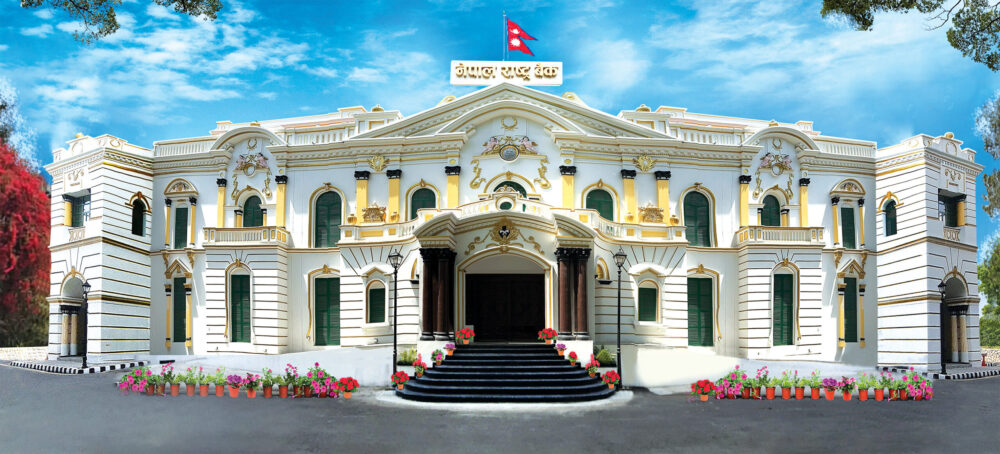

Kathmandu. Nepal Rastra Bank (NRB) has aggressively pulled money into the banking system as it has more investable money (liquidity). Nepal Rastra Bank (NRB) has issued debentures of Rs 200 billion in the last 15 days.
Nepal Rastra Bank (NRB) had issued NRB Bonds 2083 A on December 28. Nepal Rastra Bank (NRB) has issued bonds of different rates for a period of one year on January 16, 20, 22, 23, 24, 28, 29 and 30.


During the two weeks, bonds worth Rs 25 billion each were issued, Rs 20 billion and Rs 10 billion were issued twice. In this way, a total amount of Rs 2 trillion has been pulled from the market.
Earlier, the fiscal year 2072. The central bank had issued the same debentures in 1973 and withdrew Rs 49.08 billion from the market. After nearly a decade, bonds have again been used as an effective tool due to high liquidity.
Currently, there is more than Rs 10 trillion in the banking system, according to the NRB. Since there is no immediate sign of decreasing, the strategy has been adopted to hold liquidity for a long time through one-year term bonds.
Nepal Rastra Bank (NRB) has been using debentures for various years in the past as well. FY 2049. Rs 24.88 billion in 50, 2050. Rs 65.72 billion in 51, 2051. Rs 45.74 billion in 52, 2052. 9.37 billion in 2015 and 2015. In 2017, Rs 49.08 billion was withdrawn from the market.
Currently, the upper limit (Permanent Liquidity Facility Rate) of the corridor is 5.75 percent and the lower limit (Permanent Deposit Facility Rate) is 2.75 percent. If the interbank rate goes above 5.75 percent, the central bank sends money to the market, and if it falls below 2.75 percent, it withdraws money from the market.
The interbank rate has been consistently below the lower limit for the last 3 years. As a result, the central bank is regularly liquidating liquidity.
According to the latest data of the Nepal Rastra Bank, the total deposit of the banks has reached Rs 7.65 trillion and the loan flow is limited to Rs 6.895 trillion. The loan-deposit ratio of 73.97 percent is also an indication of weak demand for investment.
The private sector has complained that there is a problem as the liquidity accumulated in the financial system for the past 3 years has not been able to be invested. The slowdown in market demand and the recent Genji agitation on September 23 and 24 have further demoralized the private sector, which is one of the main reasons for the slowdown in demand for loans.
NRB officials say that continuous liquidity exploitation is necessary to make the interest rate corridor effective. Experts say that the central bank is working to boost the morale of the private sector and the liquidity accumulated will be utilized as the economy gradually returns to rhythm with the government’s initiative.
Nepal Rastra Bank (NRB) had announced to issue bonds through the Monetary Policy for the current fiscal year. Now the central bank has implemented it.
Experts say that the central bank should not be the only one to draw money through bonds. They also stressed that the government and corporations should also invest in the project by issuing such bonds.
As the liquidity in the banking system increases, the interest rates of the banks are also falling. The average interest rate on individual fixed deposits is 4.68 percent and the maximum average interest rate on institutional fixed deposits is 0.1495 percent.
In recent months, the demand for credit in the market has been low. According to the Nepal Rastra Bank, credit to the private sector from banks and financial institutions has increased by 1.9 percent (Rs 102.24 billion) as of mid-November. However, deposits have increased by 3.9 percent. This shows that deposits have increased much more than credit expansion and liquidity is also increasing. This does not show that the liquidity is still being utilized. Experts say that the central bank should still draw deposits through bonds.
Nepal Rastra Bank (NRB) has not thought of issuing bonds again for the time being. However, the bonds can be issued again if necessary. Apart from this, the central bank is regularly drawing money from the system through various devices 2 days a week. Representatives of the Rastra Bank say that the focus will be on that.
Currently, the upper ceiling (Permanent Liquidity Facility) of the corridor is 5.75 percent and the lower ceiling (Permanent Deposit Facility) is 2.75 percent. In this way, when the interbank rate is more than 5.75 percent, the central bank sends money to the market, and when the interbank rate is less than 2.75 percent, it withdraws money from the market. The interbank rate has remained below 2.75 per cent for the last three years. As a result, the central bank has been pulling money from the market.
The NRB is also using various other tools to manage excess liquidity in the market. Under this, till January 13, 2018, such equipment has been used 49 times to attract Rs 1,625.50 billion. Out of this, NRB has raised Rs 200 billion from bonds and 40 times savings and 1425.5 billion rupees.