




Kathmandu. There is a kind of tug-of-war going on right now about which direction the world economy will take. The two powers are working in complete opposition to each other.
On the one hand, recurrent crises such as energy shortages, trade conflicts and real wars are hampering economic growth. This is clearly affecting the developed economies of the world, where interest costs have increased sharply.



On the other hand, massive spending on artificial intelligence (AI) is boosting the economy. It’s amazing how small economies, in particular, have reacted to difficult situations. New trade routes, including oil and gas, have been created out of necessity.
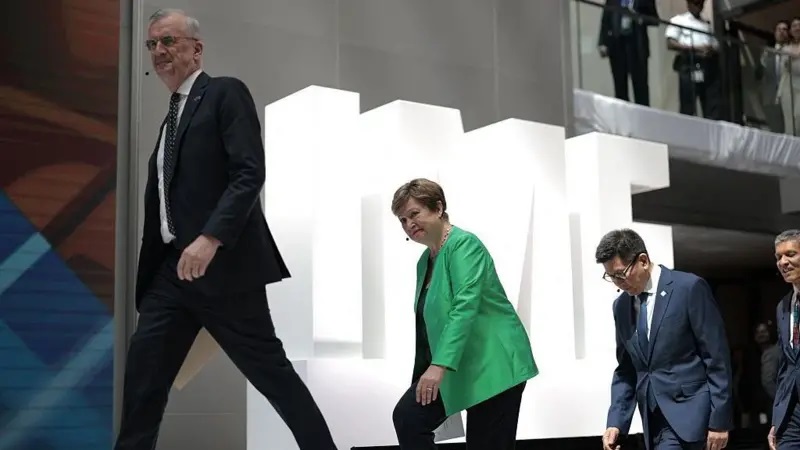
These issues were repeatedly discussed at the International Monetary Fund (IMF) meetings held in Bangkok this week. Those involved in major decisions related to the global economy also discussed it. However, they also do not know where the situation will lead.
At present, it is nothing short of a gamble to predict which other countries the bond market will focus on. Currently, its focus seems to be on the United States and France.
However, French Finance Minister Roland Lescour has said that the world has no problem raising debt. However, he had to pay a high price for it. “It doesn’t affect our budget,” he said. ’
Lescar also said that he may have helped save the G7, a group of developed countries. A year ago, the group was in danger of breaking up amid tensions caused by Donald Trump. In a way, it is a miracle that the world has not experienced an economic slowdown. Nor has any major emerging economies experienced a debt crisis.
Thailand’s finance minister pointed out that his country’s borrowing costs have risen much less than those of the United States, in particular. Another surprising development is that the bond market has stopped treating the UK as a ‘naughty student’. On the contrary, the IMF has called it a model student.
The IMF has accepted the British government’s budget plans as presented. It has put its faith in them. The reality is that the rest of the G-7 countries don’t have that much trust. It depends on who looks good and this is especially true when it comes to debt.
The opportunity gave British Chancellor John Haley the opportunity to speak. He pointed out that the UK’s real economic growth figures have consistently been better than expected. The growth so far in 2026 can be considered strong. Haley sees these figures as the first sign that investments in AI and technology are starting to boost Britain’s economic growth.
Even the major bond market investors who flocked to IMF meetings appear to be reevaluating the UK after years of crisis. But beyond the geopolitical volatility and uncertainty surrounding the bond market, a third major challenge lies ahead. This challenge was evident on the streets of Bangkok. Where drivers were taking bankers and finance ministers to this week’s meeting.
Like other countries, Thailand has experienced a sudden increase in sales of Chinese electric vehicles. Thailand is sometimes referred to as the ‘Detroit of Asia’ because of its strong automotive heritage. However, about one-third of the vehicles sold there today are Chinese electric vehicles. This is called the ‘China Shock 2’. This is the second biggest shock from China. A clear example of this is China’s rapid dominance in advanced manufacturing.
The first such shock from China came in the 2000s. At that time, China had established its dominance in basic products.
Why is the world worried?
This second wave of change has led to a new rethink of how global trade operates and how it will be managed in the future. The European Union is particularly concerned about this. It is rethinking its policies on trade between China and Europe. Because it currently looks like a one-way street.
EU rules that provide further protection for ‘Made in Europe’ products will also have a profound impact on the UK. If the UK stays out of these new rules, China could send more cars to the UK than it needs. The UK, like Thailand, currently has lower import duties and subsidies.
Another possibility is that the EU will invite the UK to join these rules. However, in return, it may ask the UK to increase import duties in line with the EU.
A different story is also unfolding in the relationship between the UK and the EU. This week in Bangkok, there was more discussion about this relationship than expected. It also amused the attendees of the meeting.
IMF Managing Director Kristalina Georgieva laughed loudly when she said, “Two divorced people who separated after Brexit are now dating each other again.” Finland’s finance minister said the UK was keen on relations with the EU. “He’s flirting.”
The big banks are also issuing reports about the possibility of Britain returning to the EU. They are calling this potential return ‘Britain’. However, the biggest hope for pulling the global economy out of this period of crisis is placed in the boom in AI.
It is expected that AI will act as a trampoline. Which will help the global economy to bounce back from these crises. Many of these crises are linked to President Trump’s decisions. However, the picture about AI is also not completely clear.
In one room, finance ministers praise the major changes that AI will bring to the economy. In another, central bank officials seem concerned that AI has the potential to breach the cybersecurity of much of the banking system. The financial market boom around AI cannot continue forever. Financial giants around the world are relieved that this boom has persisted so far. –BBC