



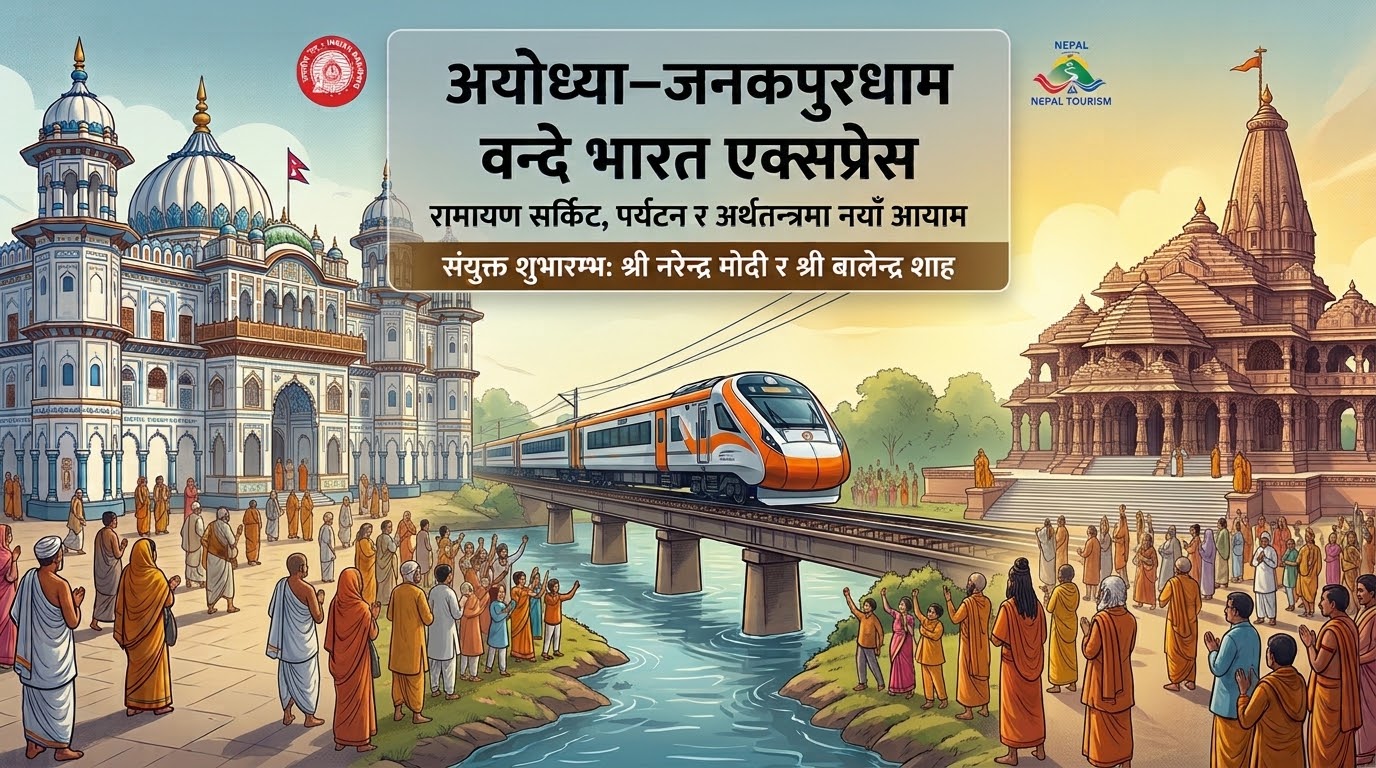

Kathmandu. The Vande Bharat Express, which will connect Ayodhya of India and Janakpurdham of Nepal, the birthplace of Goddess Sita, will be formally launched from November 23.
Indian Prime Minister Narendra Modi and Nepal’s Prime Minister Balendra Shah (Balen) are scheduled to jointly flag off the train service through virtual (video conferencing). Although the official schedule of Prime Minister Balen’s visit to India and the agenda of the visit have not been made public, the program of inauguration of the train service has been decided.


Uttar Pradesh Chief Minister Yogi Adityanath and Union Railway Minister Ashwini Vaishnaw will also be present at the special ceremony to be held at Ayodhya Railway Station.
The total length of the proposed railway route from Ayodhya Dham to Janakpurdham is about 464 km. After leaving Ayodhya, this train will reach Janakpurdham in Nepal via Jaynagar in Bihar. Arrangements have been made for the security of passengers and customs and immigration checks at Jaynagar station in Bihar.
Currently, railway service is in operation on the Jayanagar-Janakpur-Kurtha-Bijalpura (Bhangaha) section in Nepal. Of the total 68.7 km broad-gauge railway from Jayanagar to Bardibas of Mahottari, regular passenger trains are currently running on the 52-km (Jayanagar-Janakpur-Kurtha-Bijalpura) section. The remaining Bijalpura-Bardibas section (about 17 km) is under construction.
The first railway service connecting Nepal and India was the ‘Nepal Government Railway’, which was started in 1927 (1983 BS). This train operated from Raxaul in Bihar, India, to Amlekhgunj in Nepal for a distance of about 47-48 kilometers. Initially used to transport timber and later to transport passengers, this narrow gauge railway was closed in 1965 after the construction of the Tribhuvan Highway. After that, in 1937 (B.S. 1994), the Jayanagar-Janakpur-Bijalpura railway service was started.
This service was discontinued in 2014 (2070 B.S.) to upgrade the old narrow gauge railway line and convert it into broad gauge. After a gap of about 8 years, on April 2, 2022 (B.S. On 19 April 2008), the then Prime Minister Sher Bahadur Deuba and Indian Prime Minister Narendra Modi jointly inaugurated the Jayanagar-Janakpur-Kurtha section. Later, in 2023-2024, it was extended 17 km to Bijalpura (Bhangaha).
The people of the Tarai-Madhes region have cultural and family ties with Uttar Pradesh and Bihar of India. The direct train service will make visits to relatives, pilgrimage, education, health treatment (going to Lucknow, Gorakhpur or Delhi) and small business movement very cheap, fast and easy.
With the construction of a grand Ram temple in Ayodhya, lakhs of tourists visit Ayodhya every day. Indian and third country pilgrims who come to Ayodhya can now be brought directly to Janakpurdham. This will revolutionize religious tourism by completing the ‘Ramayana Circuit’.
Nepal will have a huge economic benefit from this expanded railway service, but Nepal will have to prepare for it. If Indian tourists come in the morning and return in the same train in the evening, Nepal will not be able to get the expected benefits. But if you make a standard hotel, dharamshala, night Ganga Aarti, Mithila art and culture exhibition in Janakpur, and a tour package to Pashupatinath, Lumbini and Muktinath based on Janakpur, Nepal’s service sector, employment and foreign exchange earnings will increase significantly.
On May 11, 2018, Indian Prime Minister Narendra Modi visited Janakpurdham and performed special worship at the Janaki Temple, which gave wide publicity to Janakpur at the international level. After this visit and the announcement of the ‘Ayodhya-Janakpur Friendship Bus Service’, the number of Indian religious tourists visiting Janakpur increased significantly. However, the need for improvement in the management of quality accommodation and infrastructure has been pointed out to keep up with the increase in the number of tourists.
Indian tourists are the largest base of Nepal’s tourism industry. According to the latest statistics of the Nepal Tourism Board (FY 2025/260), out of the total 1.2 million tourists entering Nepal by air alone, more than 25 percent (311,531) are Indian nationals.
Apart from this, due to the open border, more than 10 lakh Indian tourists come to Nepal annually to visit Pashupatinath, Muktinath, Janakpur, Lumbini and Pokhara through land route. Even in the off-season (rainy and winter season), Indian tourists are working as a backbone in Nepal’s gross domestic product and foreign exchange reserves, keeping Nepal’s hotels, transportation, casinos, religious places and local markets active.