





- Saurabh Dhakal
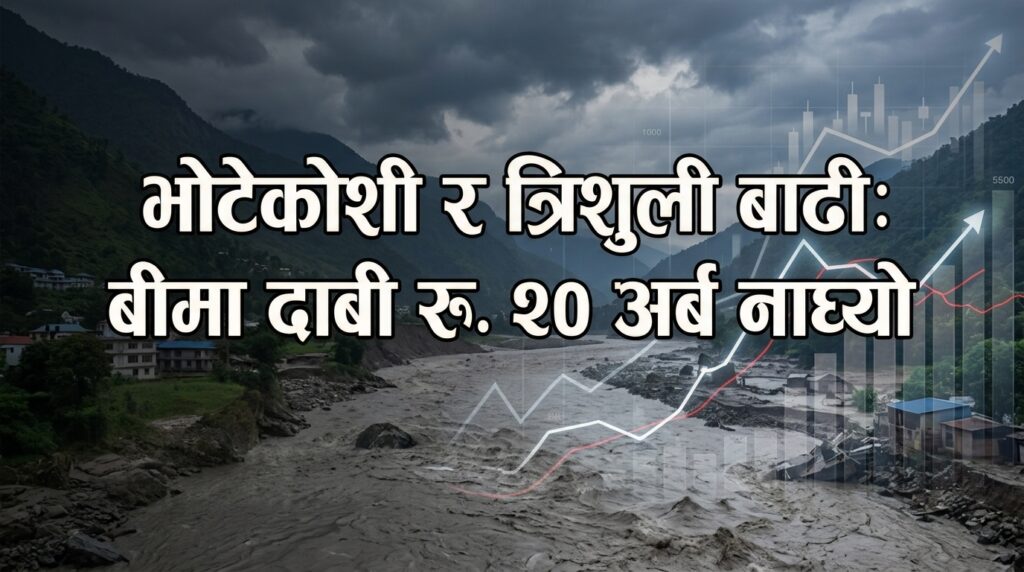
One of the questions that arose after the floods swept away the houses – “Insurance is really necessary, but when will we understand its meaning?”
By morning, he had a house. By evening, there was nothing left. The flood didn’t just sweep away the house. Years of earnings, children’s books, kitchen items, and future plans were also swept away by the water. But all that was left was his family.



That night, the children were crying in fear. The wife’s tears had not stopped. He was silently looking at the swept away house.
Suddenly, a question came to his mind. If the house had been insured, would today’s loss have been less? And another question touched him even deeper. If I had not survived this flood, what would have happened to these children tomorrow? That night, for the first time, he realized that insurance was not only a means to prevent disaster, but also a strong support to rebuild after disaster.
But the question still remains. Should we understand the meaning of insurance only after the disaster or before the disaster strikes?
Insurance may seem like an expense before a disaster strikes; after a disaster, the same insurance can become the basis of financial security.
Today, let’s start our discussion on Nepal’s insurance from here.
How big is Nepal’s insurance market? Let’s look at the facts, not the sentiments here.
According to the Insurance Authority of Nepal, in the financial year 2080. The total insurance premium collection of the life insurance business in the year 2081 was Rs. 158.11 billion. In the financial year 2081. In the year 2081, it increased to Rs. 182.27 billion. That is, the total insurance premium collection of life insurance has increased by 15.28 percent in one year. During the same period, including both life and non-life, the total insurance premium collection was Rs. 198.05 billion to Rs. 227.18 billion.
Now let’s ask the question.
The role of insurance in Nepal’s financial system is no longer a small issue. More interestingly, insurance is not just a business of selling policies and depositing money. Life insurance is a long-term financial business. A large part of the money collected from the insured is related to long-term liabilities and is mobilized only within the regulatory investment regime.
The financial health of the insurance company only means how many policies have been sold today? Not only that. There are many things to look at. How much is the liability of the company? How much is the investment? What is the status of the claim? What is the capital adequacy? What is the solvency ratio? What is the management? What is the structure of income and expenses? Therefore, an insurance company should be evaluated not by a post on social media or a sensational news, but by financial statements and regulatory indicators.
The Insurance Authority of Nepal has been publishing the financial statements of the insurance sector. Fiscal year 2082. The financial details of the life insurance sector of 83 are also going to be made public. Now comes the most important institution in the insurance sector, the Nepal Insurance Authority. ’
For any financial sector to be strong, it is not enough for companies alone to be strong. Regulation should be strong. This is the role played by the Insurance Authority of Nepal in the insurance sector of Nepal. Under the Insurance Act 2079, the Authority has been given the important responsibility of systematizing, regulating and developing the insurance business, formulating necessary policies, regulations and directives for the insurance business, establishing and licensing of insurance companies, supervising and supervising and protecting the interests of the insured. Now let’s understand it in this way. The insurance company is a player in the market; The Insurance Authority of Nepal is the regulator that makes the rules of the game and sees that the rules are follow÷ed. Therefore, it is justified to question the insurance companies. However, questions should also be raised about the regulator. Are the rules adequate? Is the implementation of the rules effective? Is it easy for the insured to get justice in the dispute of claims? Has the regulation also changed at the same pace as the risk increases? These questions will make the regulatory system healthy.
The history of the Insurance Authority is also a development. Today’s Nepal Insurance Authority is not an institution formed in a single day. As the insurance sector grew in Nepal, the need to regulate it also increased. The regulatory Travel Insurance Act, 2079, which started from the then Insurance Committee, developed into the Nepal Insurance Authority. This does not mean just changing the name of the organization. It is also an attempt to modernize the regulation as the insurance market of Nepal grows. Today, the authority has been releasing annual reports, sectoral financial statements, insurance statistics, bonus rates and various guidelines. In recent times, the provision related to risk-based capital and solvency has also been advanced. This indicates that the regulation of Nepal is moving towards looking at the risk of insurance companies not only in the traditional way but also in the direction of linking it to the nature of the risk. Then why distrust of insurance? Because many of us have been hearing unrealistic incidents related to insurance rather than understanding the real structure of insurance.
Someone said that the claim is not available. On the basis of that, we concluded that the insurance company does not give money. Someone said that the profit of the company has decreased. We said that the company is sinking. Someone wrote a financial indicator on social media wrongly, thousands of people shared it without understanding the facts.
This is where the problem lies. The financial sector should be understood not by emotion, but by financial literacy. It is not the same thing that the profit decreases and the company is weak. It is not the same thing that the expenses increase and the company is in crisis. It is not the same thing to reject the claim and the company rejecting all the claims. It is not the same thing that one incident happens and the whole system fails. This confusion will continue until the culture of reading financial statements increases. But no one can take away the right to criticize.
The insurance company should be criticized. Because both the money and the trust of the insured are important. If there is a problem in the claim process, then the question should be raised. If wrong information is given while selling the insurance policy, action should be taken. If the insured does not get the benefit he deserves, he should raise his voice. If the company does not follow the regulatory standards, then the regulator should intervene. But there is a big dark line between criticism and misinformation. That line is facts. Criticism with facts becomes a means of improvement. Allegations made on incomplete facts can become a means of mistrust between the insurer and the insured.
So when we write news, make videos or comment on social media about the insurance sector, ask ourselves one question: Is what I write making people aware or spreading panic unnecessarily?”
What to do if you don’t get a claim? Here too, one important thing needs to be understood. Social media is not the last option just because there is a dispute between the insurance company and the insured. The Insurance Authority of Nepal has been publicly calling on the authority to inform the authority if there is a problem in the payment of insurance claims. The authority has also made a provision that if there is any inquiry, complaint or problem related to insurance, one can contact the central and provincial offices.
This means that there is an institutional way to raise voice with the insured. So let’s have proof. Let’s understand the insurance policy. Let’s talk to the company formally. If necessary, let’s reach out to the regulator. But let’s not take an incomplete story on social media as the ultimate truth. The other aspect is equally important, the insurance industry has to change itself.
Supporting the insurance sector does not mean that all the work of the insurance company is right. Rather, responsible support means making corrections where there are weaknesses. Companies should explain the insurance policy in simpler language. The claim process should be made faster and more transparent.
Agents should be given the responsibility of providing not only sales targets, but also insurance literacy and accurate information. Insurers should be able to understand the meaning of the paper they have signed. Companies should consider the disclosure of their financial data as a means of trust, not a formality. And regulators should also constantly update regulations to meet changing risks, technology and financial structures.
Now an uncomfortable question – if insurance is so important, why is a large population still not fully accessible to insurance in Nepal?
According to the latest data of the Nepal Insurance Authority, the financial year 2081. The coverage of life insurance has reached 51.02 percent in 82 years, including conventional, term / foreign employment term life insurance policies; 43.31 percent when looking at conventional and term life insurance and 18.60 percent when looking at conventional life insurance only.
This data shows an important point that despite the expansion of the insurance sector, a large population of Nepal is still out of the reach of adequate insurance. In other words, the question is just how much did the insurance companies earn? It is not true. The big question is, how many Nepali families are adequately protected against financial risk? This is where the social meaning of insurance is found.
One person gets insurance. He secures some part of his future. His family is secured. Similarly, millions of people are insured. The ability of society to manage financial risk increases. Companies build long-term funds. That capital is channelized into the financial system. In this way, insurance starts from personal security and is linked to the overall economy. Therefore, it is an incomplete understanding to understand insurance only as a “business that sells policies”.
What should we do now? Neither blind support of the company. Nor blind opposition to insurance. Nor believe every allegation on social media to be true. Nor blind faith in the regulator.
What the insurance sector needs is conscious insured, responsible agents, transparent insurance companies, effective regulators, factual journalism, and above all, a financially literate society.
Let’s go back to the same man in the last scene. The flood swept away his house. He understood the meaning of insurance that day. But what do we learn from reading his story? Should we also wait for the disaster to come? Or should we calculate the risk of our family today? When he lost his house, he understood, if I had already insured? If we could ask ourselves that question before the disaster struck, perhaps this would be the first success of insurance literacy.
Because ‘insurance’ is not a promise to prevent disasters. It is a system to build a foundation for the family to rebuild financially after a disaster. And insurance. It is not wrong to question the company. But let’s ask the question with facts. It is not wrong to question the regulator. But let’s ask the question for accountability. It is not wrong for the media to investigate. But let’s not search for sensationalism, let’s do it for the truth. It is also not wrong to support insurance. But let’s be rational, not blind.
In conclusion, more important than the sensationalism of the news is the right of the citizen to accurate information. And more important than criticism of an institution is the responsibility of building a safe society. We should now look at insurance not from the rumours but from the facts. The insurance company should be evaluated not by emotion, but by financial statements, and the science of insurance should be made a matter of understanding, not of doubt. Because in order to transform our unsafe society which is surrounded by various natural hazards into a safe society, financial security has to be built before the risk comes. Only then will the real responsibility of insurance be fulfilled.
(The writer is Chief of Tokha Branch of Nepal Life Insurance) )