



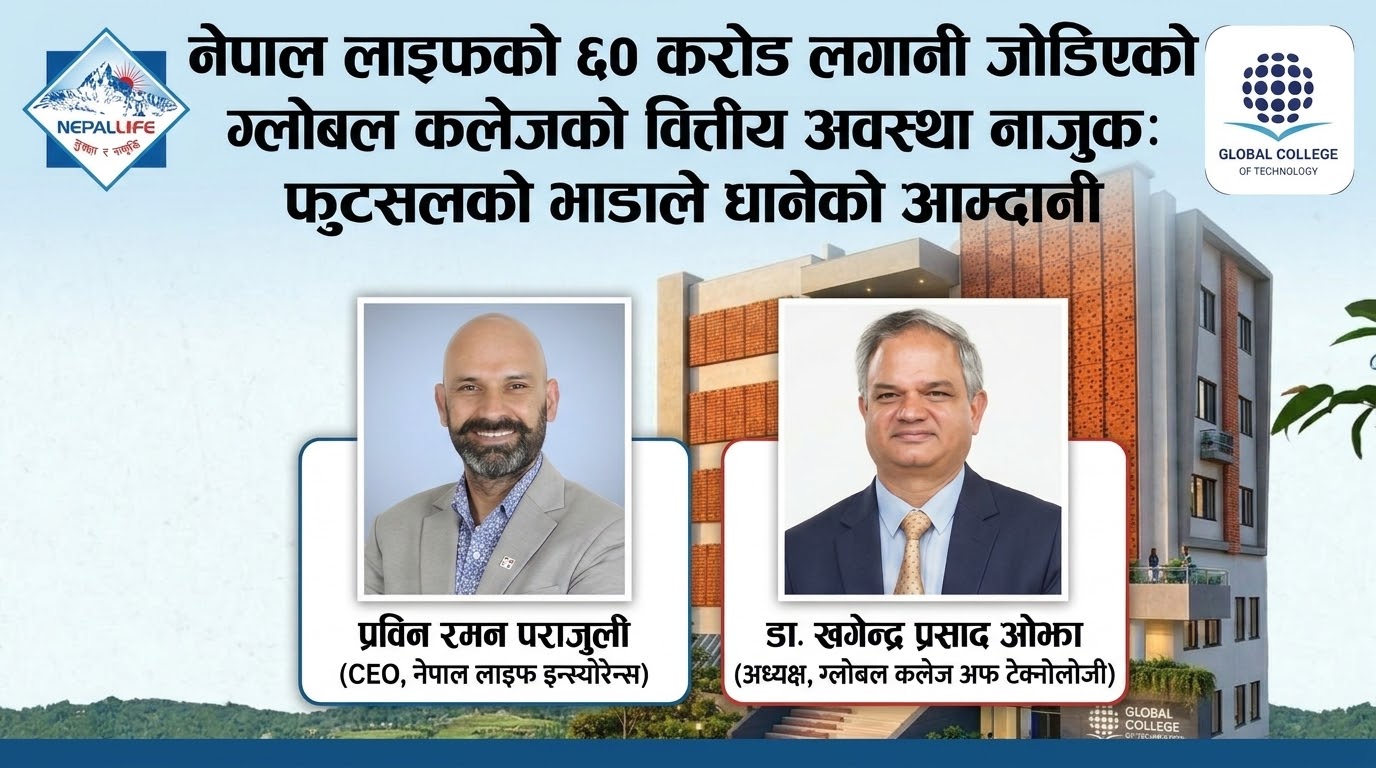

Kathmandu. The financial indicators of Global College of Technology Pvt. Ltd. (GCT) in Baneshwor are very weak due to the delay in the operation of educational programs and the interest burden of high loans.
According to the rating report released by Infomerics Credit Ratings Nepal in October 2026, the net worth of the college has become negative. The operating profit has also reached a negative level.


Despite the weak financial indicators, the college has so far maintained long-term bank loan obligations of about Rs 68.84 crore due to the ownership of a strong business group and interest-free financial support from the parent company. The rating agency has retained the loan facility in the ‘IRN B Plus’ rating indicating high risk.
What is the main source of income for the college?
According to the rating report, Global College of Technology has not yet started earning regular income from academic programs.
Futsal Ground Rental
The college earned Rs 24 million in fiscal year 2025 and Rs 26 million in 2026, the only main source of income for the college is the rent of the futsal ground.
Expectation of Upcoming Tuition Fees
}
The college has started admissions for undergraduate programmes in affiliation with the University of Huddersfield in the UK from September 2026. As of October 2026, 80 students have been enrolled and classes will begin in January 2027, so student fees are expected to be the main source of income for the college in the coming days.
Nepal Life Investments and Inherent Risks
}
Global College of Technology has 100 percent share ownership in Uniglobe Higher Secondary School, Kathmandu. Nepal Life Insurance had invested Rs 600 million to buy 47.62 percent share ownership of Uniglobe Higher Secondary School on July 22, 2081. Nepal Life Insurance has invested a total of Rs 1.33 billion in the education sector, including Rs 73,72,89,600 in professional educators on the same date.
The following serious and inherent risks are seen in this indirect investment of Nepal Life from the insured’s fund:
Negative net worth and risk of capital erosion{
}
The college has suffered a huge net loss due to delays in the operation of academic programs, increase in preparatory expenses such as recruitment of professors and building rent. This has completely drained the college’s reserve fund and the net worth has become negative in the financial year 2026. The capital erosion of the subsidiary company may have a direct impact on the investment value of parent company Uniglobe and main investor Nepal Life.
Heavy debt burden and dependence on parent company
}
In FY 2025, the debt-to-capital ratio of the college was 12.03 times, while in 2026, the ratio has become negative as the net worth has turned negative. The current ratio of the college is only 0.19 times. This shows that the ability to pay short-term liabilities is very weak. Since the college is unable to pay the interest on its own, the parent company Uniglobe is repaying the loan by providing interest-free assistance. This has also put pressure on the cash flow of the parent company Uniglobe.
Operational stabilization and intense competition risk
The academic session of the college has not yet fully started. The academic session is expected to start from January 2027. As the number of management and IT colleges affiliated to foreign universities in the Kathmandu Valley is increasing rapidly, there is a risk that the cash flow of the college will deteriorate further if the student enrollment does not meet the target.
Policy and Regulatory Risks
}
The rating report pointed out that any stringency in the Ministry of Education’s guidelines on affiliation of foreign universities, new courses and scholarships could have a direct negative impact on the college’s operations and future earnings. Despite the weak financial indicators, the college’s board of directors has an experienced group led by Dr. Khagendra Prasad Ojha, who has been active in the education sector since 2004, has its own infrastructure in a major educational hub like Baneshwor, and has the affiliation of the University of Huddersfield.
If the capital structure is not improved by increasing the number of students by conducting classes on time in the coming days, it will be challenging for the parent company Uniglobe and indirect investor Nepal Life Insurance to become profitable.