



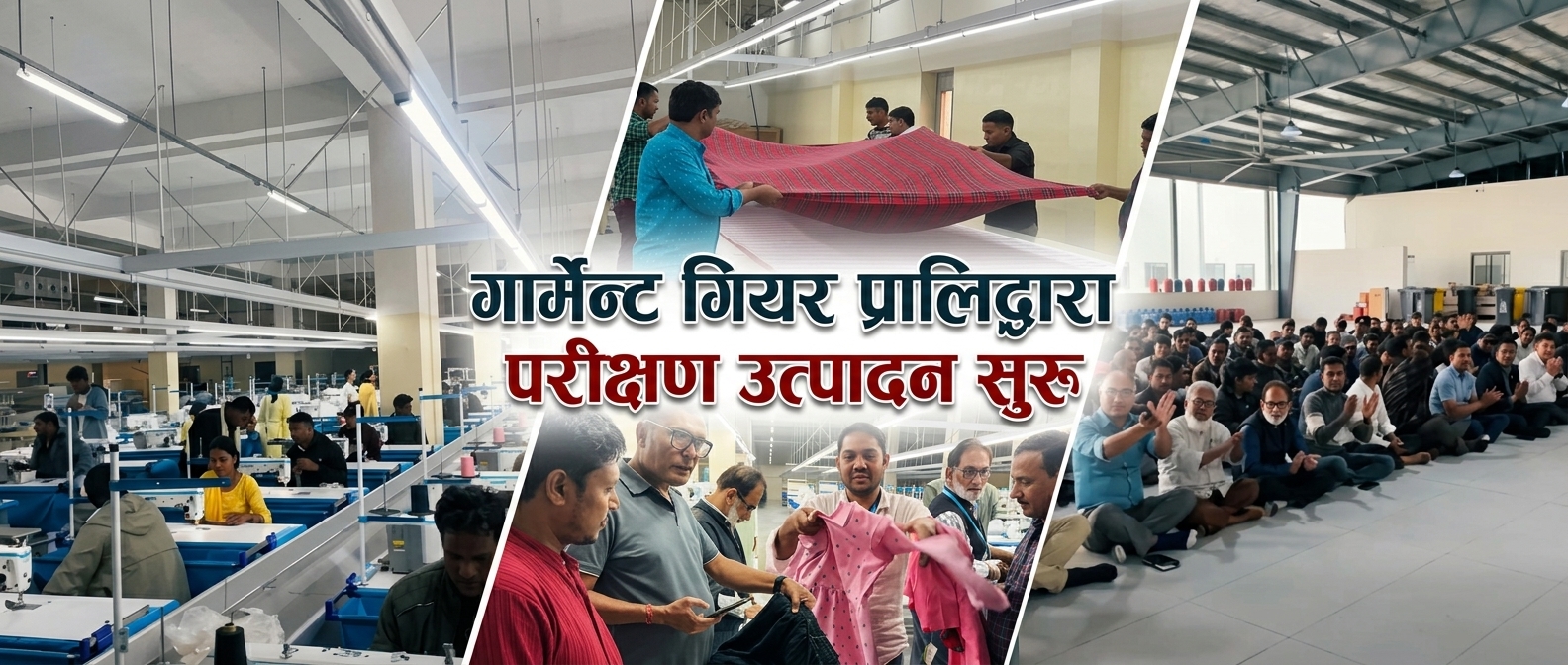

Kathmandu. Garment Gear Pvt. Ltd., under construction in the Bhairahawa Special Economic Zone (SEZ), has started its production. This industry, with investments from Min Bahadur Gurung, owner of Bhatbhateni Supermarket, and Umesh Shrestha of Little Angels Group, was laid last year.
In terms of investment and production capacity, it is one of Nepal’s largest garment industries. After seeing good profits and potential in the ready-made garments among the products sold at Bhatbhateni Supermarket, the Bhatbhateni Group started producing it themselves. Even now, Bhatbhateni sells preparatory garments from most local producers.



The industry involved workers in an 8-week training through professional and experienced trainers to enhance their skills.
Businessmen Meen Bahadur Gurung and Umesh Shrestha have invested more than 1.5 billion rupees, and nine buildings spread over 150,000 square feet have been constructed within the premises of this industry.
The industry is based on semi-automated technology, where modern machines imported from Japan, China, Italy, Hong Kong, and Singapore are being installed. There is a fully air-conditioned structure, a canteen, a medical unit, a restroom, and convenient restrooms for workers.
The industry has also obtained certifications in ethical trade, supply chain, and social responsibility from international auditing organizations such as ‘Sedex’ based in London.
Besides underwear, the industry will produce casual and sportswear for women, men, and children, including T-shirts, trousers, tracksuits, shirts, pants, half-pants, and jackets. It has the capacity to produce 300,000 to 400,000 units monthly and 3.5 million to 5 million units annually.
Although SEZ regulations require at least 60 percent of exports to be recognized as an exporting industry, the company plans to export 70 percent of its production to India, Europe, America, the Middle East, and Japan. The remaining 30 percent aims to sell in markets across the country, including Bhattbhateni supermarkets.
This industry will provide employment to 400 people in the first phase. Three months later, in the second phase, an additional 400 people are planned, and by the start of the upcoming fiscal year 2084/85, the third phase will be completed, providing a total of 1,200 direct employment.
The foundation stone was laid on Jestha 21, 2082 CE, and due to economic slowdowns and the ‘Genji Movement’ of Bhada, the industry started operations several months later than scheduled. Currently, raw materials (textiles) for the industry are imported from India, China, Thailand, and Bangladesh.