




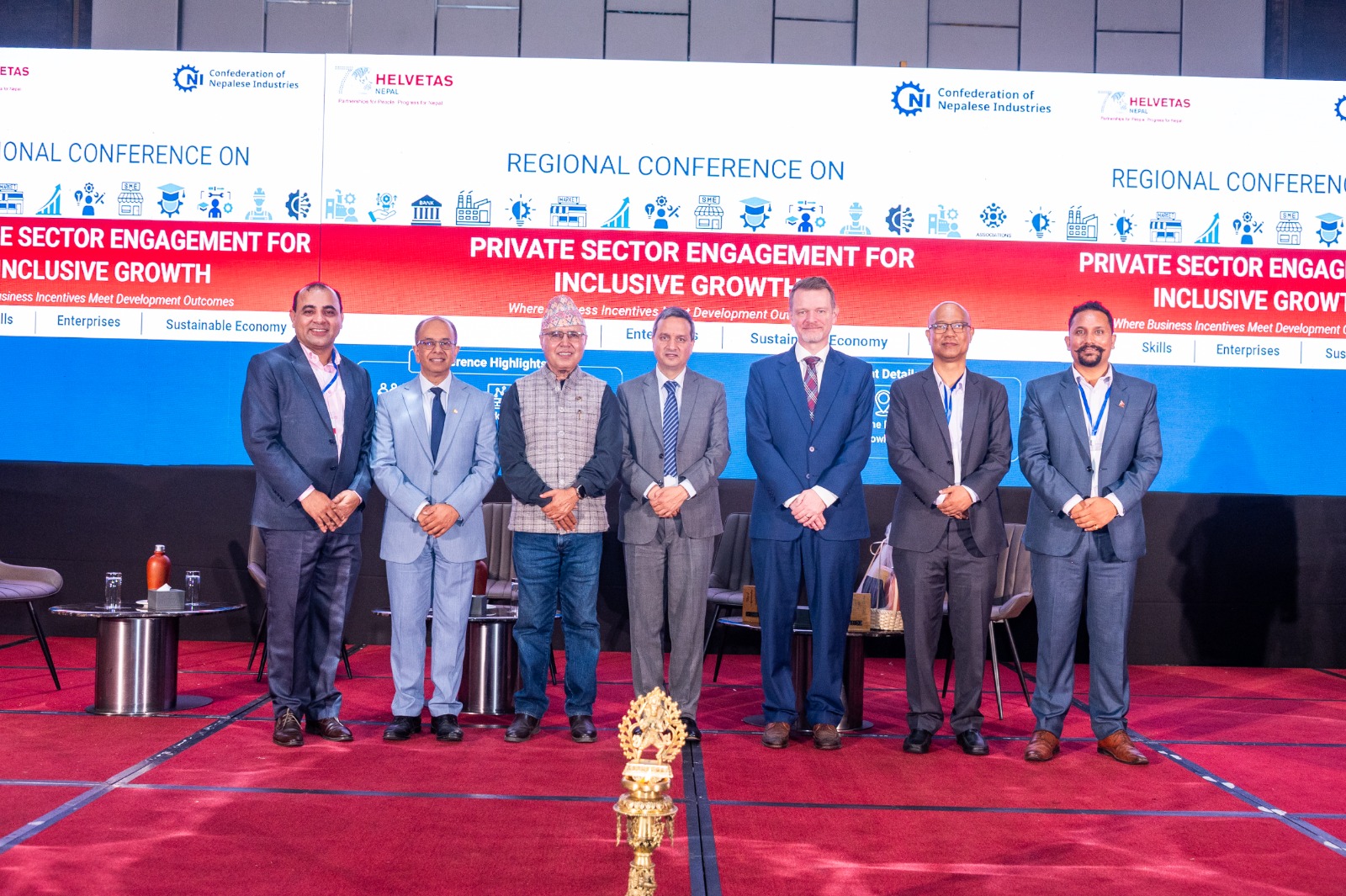

Kathmandu. The regional conference ‘Engagement of Private Sector for Inclusive Development’ concluded in Kathmandu on Friday. The conference was jointly organized by the Confederation of Nepalese Industries (CNI) and Helvetas Nepal with the theme “Confluence between Business Incentives and Development Outcomes”.
Best practices on skill development, entrepreneurship promotion, and private sector engagement in sustainable economic development were discussed, and how such practices can be adapted and scaled up to meet emerging challenges.



Discussions focused on how business, government and development partners can work together to create both business value and positive social impact, and build a more resilient and inclusive economy.
The chief guest of the program, Vice-Chairman of the National Planning Commission, Dr. Mr. Gunakar Bhatta reiterated the government’s commitment to creating a conducive environment for investment, innovation, entrepreneurship and private sector-led economic growth. “The public sector alone cannot be the sole engine of economic growth,” he said, underlining the need for more active role of the business sector in the country’s development journey. Noting the limitations of the state’s financial resources and operational flexibility, he said that “the path to inclusive growth must be built through a dynamic private sector” and stressed that enterprises should be encouraged to integrate marginalized sectors, small businesses and under-utilized labour force into regional and global value chains.
On the occasion, former Finance Minister Rameshwor Khanal highlighted the central role of private sector in productivity, innovation, investment and job creation in Nepal. Stressing on the need to create a more conducive environment for businesses, he said, “If Nepal is to meet its ambitions of investment, export, energy development and job creation, businesses should invest confidently and create an environment where the government can play the role of facilitator rather than controller.” ”
President of Confederation of Nepalese Industries (CNI), Birendra Raj Pandey, emphasized the importance of collaborative efforts to address challenges related to employment and strengthen economic competitiveness of Nepal. “Future calls for a new development agreement,” he said, adding that the agreement should be based on “trust, collaboration and shared responsibility among government, business, workers, development partners and communities.”
Presenting a regional perspective, Helvetas Asia Region Coordinator Dr. “Private sector engagement is not just about mobilizing additional resources: it is a process of building structured partnerships that create shared value,” he said, adding that development cooperation is “gradually transitioning from a traditional grant-based model to a model of technical cooperation that creates systemic impact through co-financing, blended financing arrangements, and mobilization of private sector investment.” “This highlights the growing importance of strategic business partnerships for building strong development outcomes and a resilient economy,” he added.
Matthias Mayer, Deputy Chief of the Swiss Development and Cooperation Agency, highlighted Switzerland’s long-term commitment to market-oriented development and economic inclusion, saying “the private sector is essential for sustainable development”.
Delegates from Nepal, Myanmar, Bangladesh and Vietnam shared their experiences and best practices, challenges and opportunities through three thematic sessions on Skill Development, Entrepreneurship Promotion and Sustainable Economic Development.