



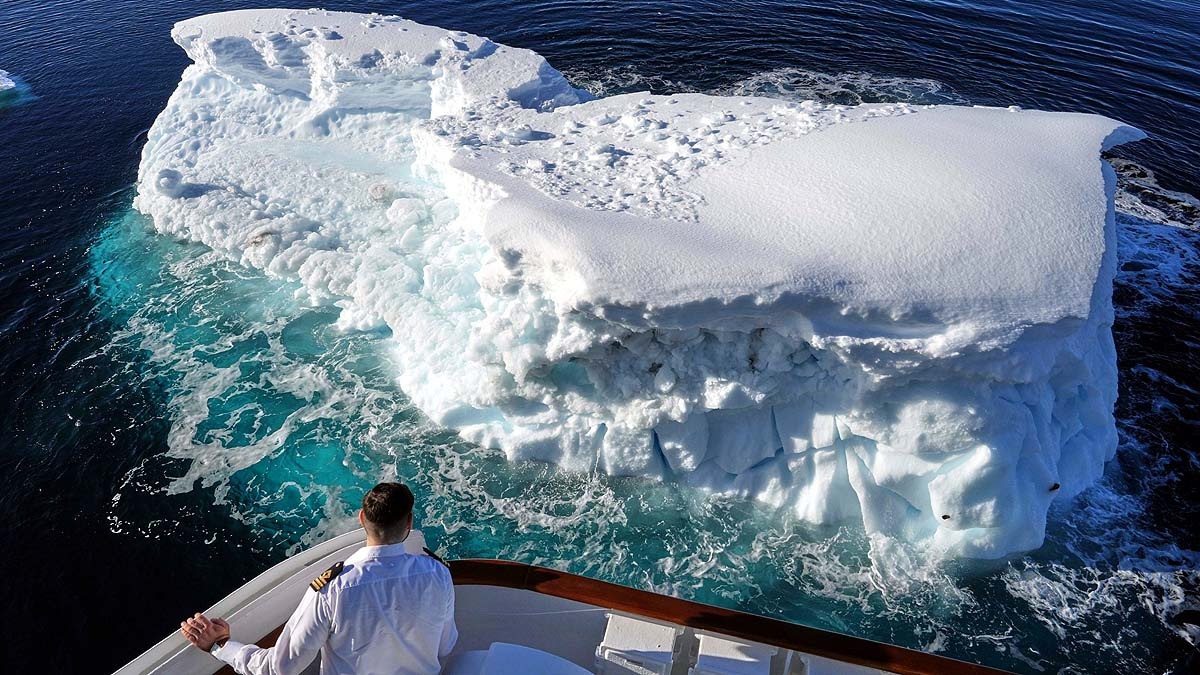

Kathmandu. A new study by scientists has revealed surprising statistics. From 1979 to 2023, about 12.5 trillion tons of Greenland and Antarctica’s ice sheets have disappeared combined. That’s enough ice to create a layer five feet thick across the entire continental United States. This loss has caused a 3.1 cm rise in global sea level.
The study, published in the journal Scientific Data, quoted lead author Ines Otosaka as based on data from 27 satellite missions. Previously, scientists only looked at data from the 1990s.



It has now been expanded to the 1970s, combining data from older satellites of NASA and the European Space Agency. Data has been available for Greenland since 1972 and for Antarctica since 1979. It clearly shows the changes that have taken place over half a century.
Most importantly, 84 percent of the ice loss is not due to surface melting from the hot air, but due to the erosion of warm seawater from the bottom and shore. Glaciers are flowing into the ocean at a rapid rate. Only 16 percent of the damage is due to surface melting.
Co-author Andrew Shepherd warned that this represents a quarter of sea level rise. That puts an additional 6 to 9 million people at risk of coastal flooding.
Greenland has lost about 60 percent of its ice and Antarctica has lost 40 percent. Although small, Greenland is losing more ice.
In the 1980s, Greenland lost about 60 billion tons of ice annually. In the 2010s, this rate increased to 264 billion tons. Damage in Antarctica has also quadrupled. In places like the Jakobshavn Glacier, it is now receding up to 50 meters a day.
Impacts on sea level and people
A 3.1-centimeter rise may seem small. However, for every centimetre of sea level rise, 20 to 3 million people face flooding at least once a year. This melting ice turns into about three quadrillion gallons of water. People living in coastal cities, islands and low-lying areas will be the most affected.
According to scientists, the changes are a few decades behind global warming. Therefore, even if global warming stops, ice loss will continue for some time. This is the longest satellite-based record. This clearly shows that the damage has intensified since the 1990s. Warm oceans are weakening glaciers. As a result, they are flowing faster. This is called dynamic imbalance.
Studies show that ice sheets are now a major driver of sea level rise. “More damage is possible,” scientists warn. Global efforts are needed to protect coastal areas. Continuous satellite monitoring can help us understand these changes and plan for the future. Melting of the polar regions is not only a local problem but a challenge for the entire world. ’